
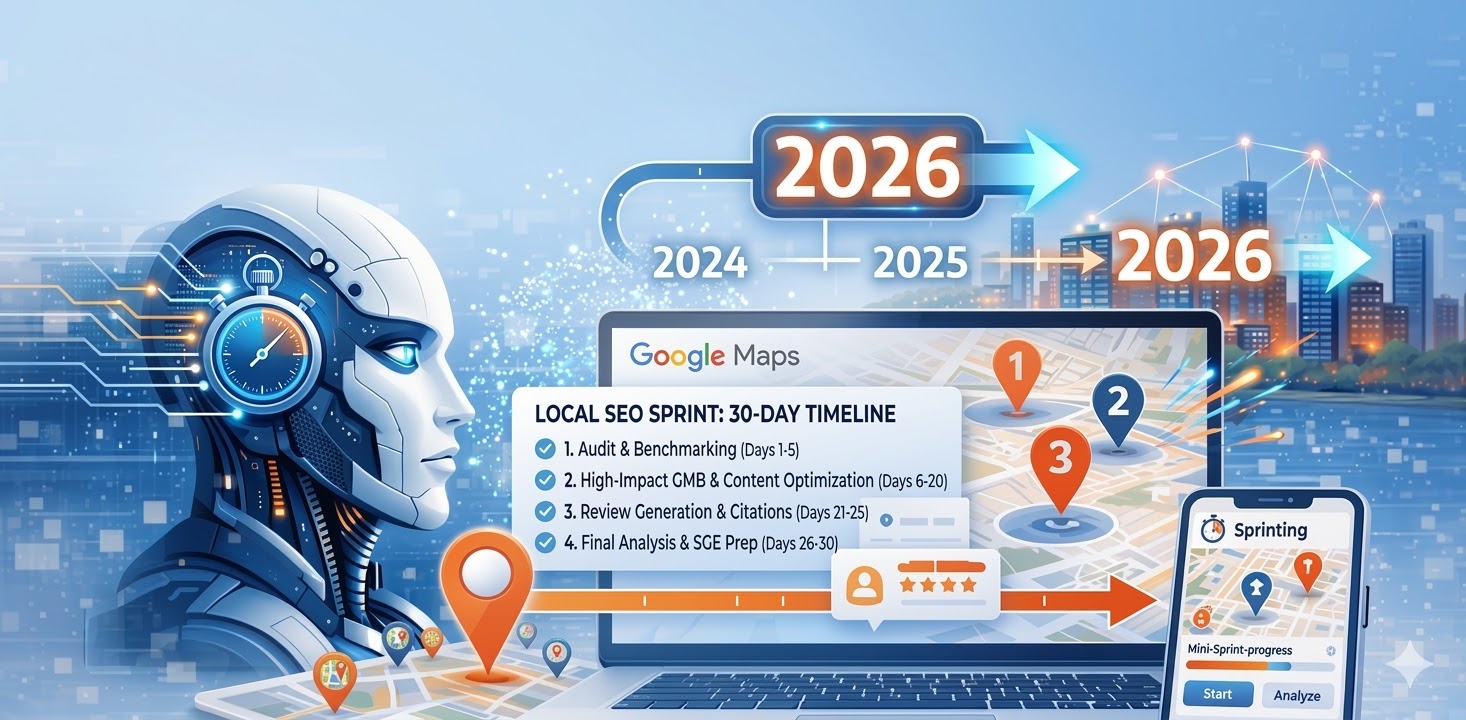
Quick Summary
- Local SEO sprint is the only sustainable growth model for service brands in 2026’s AI-driven map ecosystem.
- A structured 90 day local SEO plan broken into foundation, expansion, and authority phases for measurable ranking gains.
- How to execute a modern Google Maps ranking strategy using entity authority, review velocity, and hyper-local content.
- The operational local SEO roadmap that turns map visibility into booked calls and real revenue.
- Weekly execution metrics and tools that make a Local SEO strategy for service businesses 2026 predictable, scalable, and performance-focused.
- A data-driven Local SEO framework that aligns Google Business Profile optimization, local authority signals, and conversion-focused website improvements to dominate the local pack in 2026.
Local search in 2026 is no longer predictable. Rankings shift faster, AI summaries intercept clicks, and Map results change by the week. According to Statista, global digital ad spending is projected to surpass 870 billion US dollars in 2026, meaning competition for visibility is fiercer than ever. A focused Local SEO sprint helps service businesses move with speed, not guesswork.
If you run a service-based company, waiting six months for results is not a strategy. You need a structured Local SEO strategy for service businesses that drives calls, bookings, and real revenue within a defined 90-day window. This guide breaks down exactly how to execute that plan with clarity and control.
Let’s get started!
What Is a Local SEO Sprint And Why Does It Matter More in 2026?
A 90 Day Local SEO Sprint is a focused action plan where you improve your Google Business Profile, website pages, and local signals within a clear three-month window. You focus on structured 30-day phases instead of random monthly tasks. Each phase includes priority actions that aim to boost your rankings and generate more local leads.
In 2026, local rankings change quickly because of AI updates and spam filters. So, focused, revenue-driven strategies are more important than slow, generic optimization.
- 30 Day Execution Blocks: Focus on one core pillar at a time such as foundations, content, or authority to create concentrated ranking impact.
- Revenue First KPIs: Track calls, bookings, and direction requests instead of vanity keyword positions.
- Measurable Tracking: Use grid-based tools to monitor proximity gains across service areas.
- Operational Structure: Build a repeatable system that scales across multiple locations or branches.
The 90-Day Local SEO Sprint (Phase-Based Execution Model)
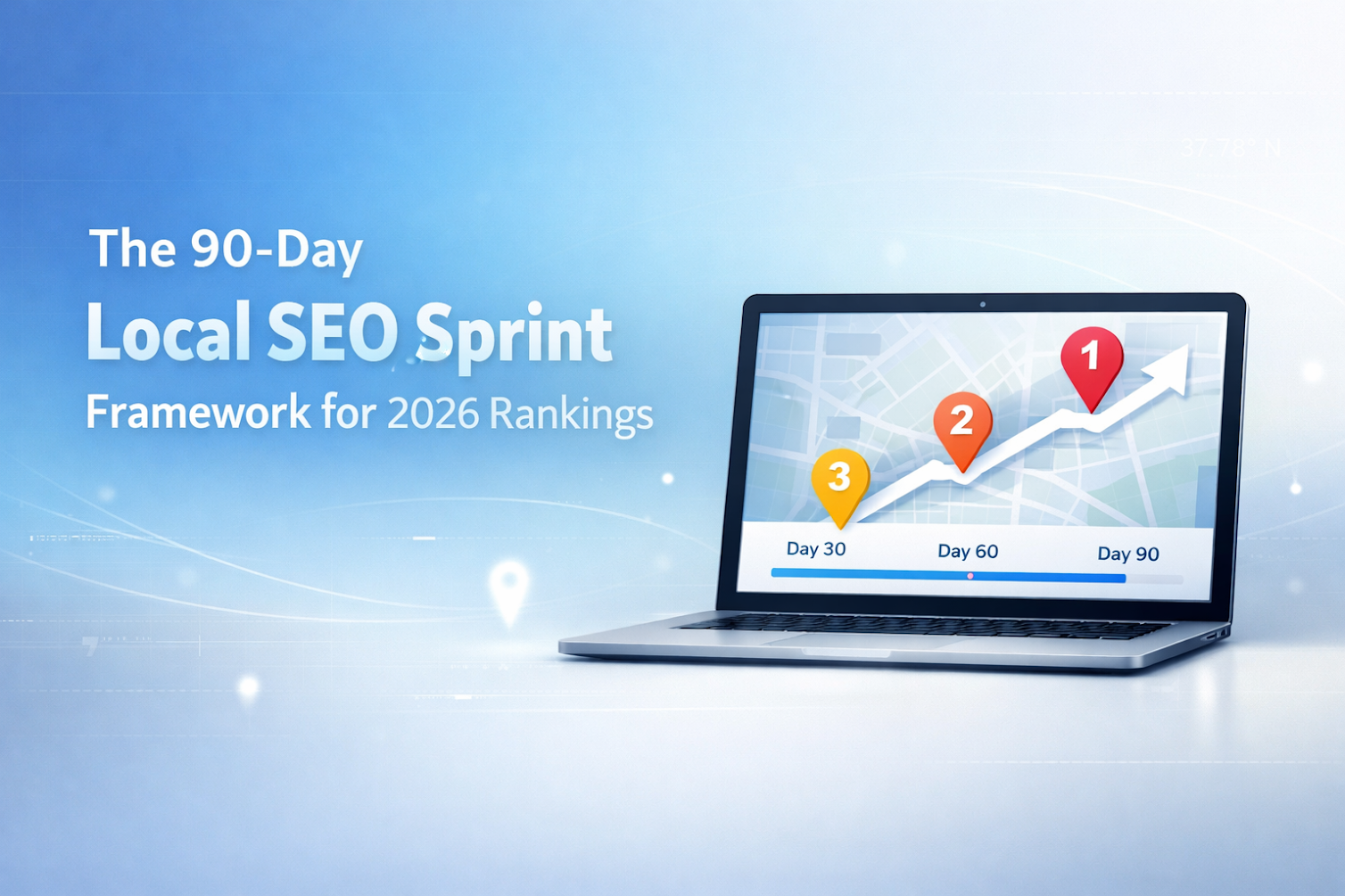
To see results, you must follow a structured local SEO roadmap that builds authority layer by layer.
Phase 1 (Days 1–30): Foundation & Entity Authority
The first month is about Google Business Profile (GBP) entity optimization. We are not just filling out a profile; we are establishing your business as a trusted entity in the Google Knowledge Graph. This involves hard-coding your entity authority through Local Business Schema JSON-LD.
Baseline Table
| Metric | Current Status | Target | Tool Used |
| Avg. Map Rank (5-mile) | #8 | #3 | BrightLocal |
| Organic Impressions | 1,200/mo | 2,000/mo | Search Console |
| Monthly Calls | 15 | 30 | CallRail |
| Profile Completeness | 70% | 100% | GBP Dashboard |
Once the baseline is recorded, execution begins with priority cleanup and authority alignment tasks that directly impact local pack ranking factors.
- Fix NAP consistency across all major directories
- Optimize primary and secondary GBP categories
- Add structured data for local SEO on core pages
- Audit existing citations and remove duplicates
- Upload geo tagged images and service specific posts
Entity Signal Strengthening Checklist
| Task | Priority | Expected Impact | Timeline |
| GBP Optimization | Critical | High Map Visibility | Week 1 |
| Schema Markup | High | Improved Rich Snippets | Week 2 |
| Citation Cleanup | Medium | Trust & Authority | Week 3 |
| GSC Setup | High | Data-Driven Tracking | Week 1 |
Your business needs to show improved map visibility and complete business information, and increased local search rankings by the end of Phase 1. This foundation ensures the next phases build on authority rather than weak structural signals.
Phase 2 (Days 31–60): Content & Build Authority
Month two of your Local SEO sprint focuses on expanding relevance and strengthening trust signals. This stage of your 90-day local SEO plan builds authority. It directly impacts local pack rankings and strengthens your Google Maps strategy.
1. Publish Hyper Local Content Assets
Create location specific content that answers real customer questions and supports Zero click search optimization instead of chasing generic keywords.
- Create city specific buying guides and cost breakdown pages
- Build neighborhood level service landing pages
- Add FAQ sections answering how to rank in Google Maps 2026 style intent queries
| Content Asset | Purpose | SEO Impact |
| City Service Pages | Target high-intent local searches | Proximity relevance |
| Cost-Based Articles | Capture pricing queries | Zero-click visibility |
| Neighborhood Pages | Expand geographic footprint | Map visibility |
| Local FAQs | Answer real search questions | Entity-based authority |
2. Review System and Reputation Control
Reviews are a core ranking signal in Local SEO strategy for service businesses 2026. Consistency and response behavior matter more than sudden spikes.
- Request reviews through SMS or email after job completion
- Respond to every review within 24 hours
- Use service and city terms naturally in replies
| Review Action | Execution Method | Ranking Benefit |
| Review Requests | Automated SMS or email | Steady review velocity |
| Review Responses | Professional & location-specific | Trust and engagement |
| Keyword Usage | Natural service mentions | Relevance reinforcement |
| Weekly Monitoring | Track growth trends | Stable ranking factors |
3. Earn Local Authority Links
Backlinks validate credibility and strengthen your Google Maps ranking strategy. Focus on relevance over volume.
- Join local chambers of commerce
- List in verified trade associations
- Contribute to community blogs
| Link Source | Example | Authority Impact |
| Chamber Listings | City business chambers | Local trust validation |
| Trade Associations | Industry directories | Entity credibility |
| Community Blogs | Local city publications | Geographic relevance |
| Sponsorships | School or event websites | Brand authority signals |
By the end of Phase 2, your local presence is supported by structured content, controlled review velocity, and relevant authority links. This layer strengthens your local SEO sprint and prepares your business for intense ranking movement in the final stages.
Phase 3 (Days 61–90): Conversion Optimization & Visibility Enhancement
In the final 30 days, your focus shifts from rankings to revenue. This stage improves your service business SEO strategy. It turns traffic into calls and boosts map visibility in key service areas. This leads to sustainable local growth.
Priority Actions
- Implement Mobile-first design improvements across key service pages
- Add click-to-call buttons above the fold on every high-intent page
- Place testimonials near CTAs to improve trust and conversions
- Optimize service pages for speed and user experience
- Strengthen internal linking between top-performing geo pages
| Optimization Task | Target Goal | Expected Outcome |
| Mobile-First Design | < 2.5s Load Time | Lower Bounce Rates |
| Click-to-Call Buttons | Primary Mobile CTA | 25% Increase in Leads |
| Heatmap Analysis | Data-Backed Layout | Higher User Engagement |
| Map Monitoring | Track Ranking Shifts | Sustained Map Visibility |
| Local SEO for Small Businesses | Peak Pack Position | Dominant Market Share |
By the end of Phase 3, your local SEO for small businesses framework moves from visibility to dominance. The goal is simple: more calls, better conversion rates, and stable map rankings supported by user behavior signals and clear authority. This is where your 90 day execution turns into predictable local revenue.
Tools to Execute a 90-Day Local SEO Sprint
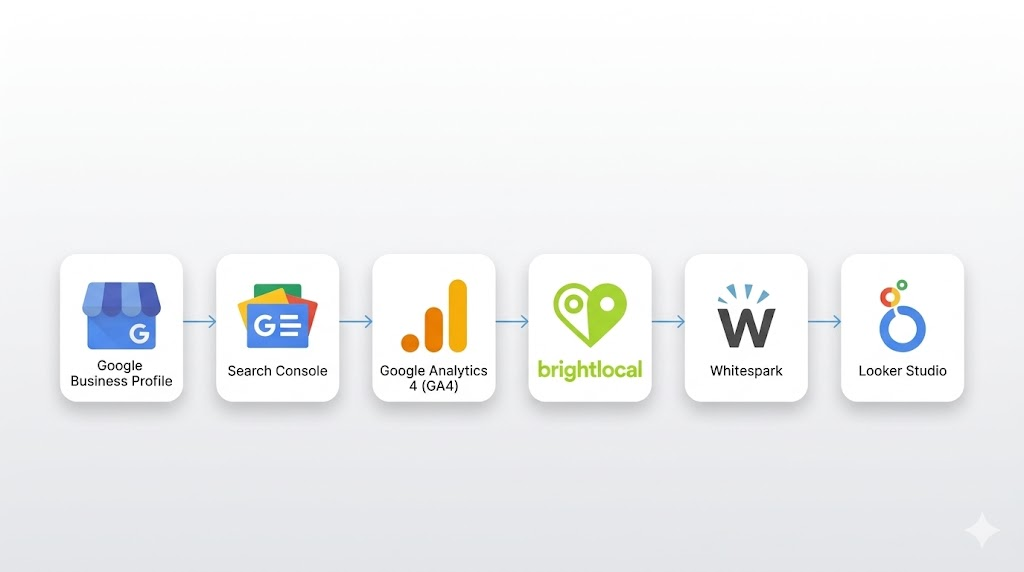
To manage a sprint effectively, you need a focused tech stack that turns data into decisions and rankings into revenue.
- Google Business Profile: Your primary control hub for map visibility, customer interactions, posts, local SEO services, and review management. This directly influences local pack rankings and engagement signals.
- Google Search Console: It tracks search queries, indexing health, and local impressions. This helps you see how your pages do in local searches.
- GA4: Monitors key events such as form submissions, click to call actions, and user journeys across service and geo-targeted pages.
- BrightLocal: Provides grid-based rank tracking and citation audits to measure proximity movement and identify inconsistencies in listings.
- Whitespark: Supports structured citation building and cleanup to strengthen NAP consistency and entity authority.
- Looker Studio: Visualizes rankings, calls, impressions, and conversions in a single dashboard to connect SEO execution with measurable revenue impact.
Common Local SEO Mistakes That Kill Momentum
Even a well planned Local SEO sprint can lose momentum when small but critical mistakes creep in. Before you scale visibility, make sure you are not unknowingly damaging your rankings with the following common errors.
- Over-optimizing Categories: Adding unnecessary secondary categories to your Google Business Profile confuses the algorithm. This can weaken your entity authority.
- Spammy Citations: Quantity over quality in citation building is a 2018 tactic. In 2026, one high-authority local chamber link is worth 100 generic directory listings.
- Ignoring Proximity Signals: Trying to rank 50 miles away without a physical presence or a dedicated Hyper-local content roadmap will result in suppressed rankings.
- Buying Reviews: Modern AI filters detect unnatural patterns instantly. This is the fastest way to get a permanent suspension.
Weekly Execution Blueprint & Metrics That Actually Move Revenue
A Local SEO sprint requires weekly accountability to ensure the MAP Pack visibility signals are trending upward.
Week 1–4: Baseline & Cleanup
Focus on fixing NAP consistency (Name, Address, Phone) across the web and performing a deep audit of your Google Business Profile (GBP) entity optimization.
Week 5–8: Expansion
Launch your Hyper-local content roadmap. Build pages for your top 3 revenue-generating neighborhoods. Start an aggressive citation-building campaign on niche-specific sites.
Week 9–12: Optimization
Review your Call tracking for local SEO data. Identify which pages are driving leads and double down on internal linking upgrades. Adjust your Google Maps ranking strategy based on the 60-day heatmap results.
Weekly KPI Tracking Table
| Week | Primary Action | Target Metric |
| 2 | NAP Audit | 0 Critical Errors |
| 6 | Geo-Page Launch | Indexed in Search Console |
| 10 | Review Generation | +4 Net New Reviews |
| 12 | Final Reporting | 20% Increase in Actions |
How a 90 Day Local SEO Plan Drives Real Revenue
A structured 90 day execution model works because it fixes what actually impacts rankings and conversions. Instead of focusing on keywords, enhance entity signals. Look at review velocity, proximity relevance, and on-page conversion elements. These aspects directly impact calls and bookings.
What changes in practical terms:
- Proximity-Based Expansion: Use localized service pages to “pull” your map pin into neighboring zip codes where your competitors are currently weak.
- Behavioral Signal Optimization: High click-through rates from click-to-call buttons signal to Google that your business is the most helpful local entity.
- LSI & Topical Depth: Using local landmarks and neighborhood terms goes beyond basic keywords. This creates clear geographic relevance.
- AIO Dominance: Structured data and FAQ assets ensure your business is the cited source in AI-generated search overviews.
Ready to dominate your local market? Book a strategic session to build your own custom Local SEO sprint today.
Final words
A structured Local SEO sprint is no longer optional in 2026. Service businesses that win are those that execute with clarity, track the right metrics, and align entity authority, proximity signals, and conversion optimization into one focused 90 day growth system supported by professional local SEO services.
If you are ready to turn map visibility into predictable revenue, partner with Mount Web Technologies, a results driven local SEO agency. Our team delivers strategic local SEO services built for measurable growth. Book your strategy session today and start scaling with confidence.
FAQ
What is a Local SEO sprint?
A Local SEO sprint is a 90-day plan. It focuses on improving Google Business Profile signals, website authority, review speed, and proximity relevance. This helps boost map rankings and generate more local leads.
How is a 90-day local SEO plan different from ongoing SEO?
A 90-day plan is time-bound and action-driven. It prioritizes high-impact fixes and authority building in structured phases, while ongoing SEO focuses more on maintenance and gradual optimization.
How long does it take to rank in Google Maps in 2026?
Most businesses see measurable movement within 45 to 90 days. Foundation improvements may show results in 30 days, while authority building and content expansion typically influence rankings by the third month.
What affects local pack ranking factors the most?
Proximity signals, entity authority, NAP consistency, structured data, and steady review velocity are the most influential ranking drivers in 2026. Google prioritizes trusted, verified, and locally relevant businesses.
Is Google Business Profile optimization still important?
Yes. Google Business Profile remains the core ranking asset for local visibility. Incomplete or poorly managed profiles weaken map visibility regardless of website optimization efforts.
What are the essential steps in a 90-day local SEO plan for small businesses?
Key steps are:
- GBP optimization
- Citation cleanup
- Schema implementation
- Hyperlocal content creation
- Review generation
- Backlink acquisition
- Conversion optimization, like click-to-call enhancements
What platforms are recommended for tracking local search rankings? BrightLocal and Whitespark provide grid-based local tracking. Google Search Console and GA4 measure impressions, traffic, and conversions. Looker Studio helps visualize ranking movement and revenue correlation.
What services help with local citation building?
Professional citation services audit inconsistent listings, remove duplicates, and submit verified business data to trusted directories. This strengthens entity authority and improves overall map visibility.
How can review management software support a 90-day SEO strategy? Review tools automate requests, track review velocity, monitor sentiment, and ensure timely responses. Consistent review growth builds trust signals and stabilizes local pack rankings.
Where can I find a reliable local SEO agency for a structured sprint?
Choose a local SEO agency with a proven sprint framework, transparent reporting, and measurable results. Mount Web Technologies delivers structured 90-day execution models focused on calls, conversions, and map dominance.