

What You Will Learn
- How to write a blog that Google ranks in 2026 starts with search intent research, not with writing. The topic and angle decide everything before a word is typed.
- Word count does not directly determine ranking. Depth and intent match. A focused 900-word post consistently outranks a padded 3,500-word post on the same topic.
- New content typically takes three to six months to reach stable ranking positions. Lower-competition keywords can show results within weeks.
- Blog writing best practices in 2026 include an answer-first structure, where each section opens with the direct answer before explanation, because Google and AI Overviews both extract from the first sentence of each H2 block.
- You do not need perfect English or prior SEO knowledge to start. A clear structure, a real answer, and consistent publishing are the three things that build ranking blogs.
- Benefits of blog writing extend beyond traffic. Blogs build topical authority, support internal linking, generate leads, and increase the chance of AI Overview citations that convert at 4x the rate of standard organic clicks.
Most people who want to write a blog start with the wrong question. They ask what to write instead of asking who is searching, what they actually want, and what format already ranks for that search. In 2026, Google’s algorithm evaluates intent match before it evaluates writing quality. A poorly structured blog that matches search intent perfectly will outrank a beautifully written one that misses it. This guide explains how to write a blog that ranks on Google in 2026. It walks you through each step, beginning with what you should decide before opening a document.
This applies whether you are a beginner with no experience, a business owner writing for leads, or a marketer building a content strategy for a B2B brand. The process is the same. The depth at which you execute it is what changes the outcome.
What Is Blog Writing and Why It Still Works in 2026
What is blog writing? It is the process of creating structured, helpful content on a website to answer a specific question, solve a specific problem, or explain a specific topic. A blog post is not a random article. It follows a clear structure with a defined topic, clear subheadings, and a single goal per post. That structure is what makes it findable by search engines and useful to readers.
Is blog writing still worth it today? Yes, and the data supports this strongly. Websites that publish consistent blog content generate 67% more leads per month than those that do not. Businesses with active blogs earn 97% more inbound links on average. In 2026, the benefits of blog writing also include AI citation eligibility. A well-structured blog with FAQPage schema is one of the highest-probability content types to be cited inside Google AI Overviews, which convert at four times the rate of standard organic traffic.
Can blog writing help me earn money? Directly and indirectly. Directly through affiliate links, sponsored content, and digital products if you build an audience. A single blog post can generate leads for a business. If it ranks well for the right keyword, it can bring in qualified inquiries for months or even years, all without extra investment.
How to Write a Blog Post Step by Step: The 2026 Process
Writing a blog post in 2026 follows a specific sequence. Skipping any stage produces content that is either unfindable or unrankable even when the writing itself is strong.
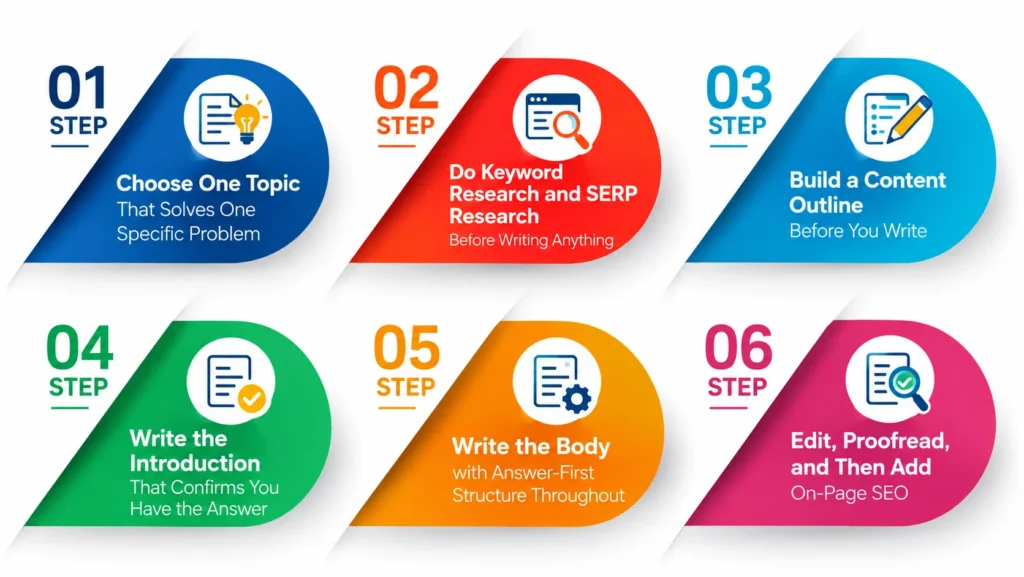
Step 01: Choose One Topic That Solves One Specific Problem
The most common reason blogs do not rank is topic dilution. One blog post must target one search intent. Topic selection starts by asking what one specific question your ideal reader is typing into Google right now. The narrower the topic, the stronger the ranking potential. A post titled “How to Write a Blog” competes broadly. A post titled “How to Write a Blog Post as a Beginner with No Experience” targets a far more specific intent and faces significantly lower competition.
- Use Google’s People Also Ask section to find exact question phrasing your audience uses
- Check the autocomplete suggestions in Google Search for variations of your topic
- Look at what questions appear in the Related Searches section at the bottom of the SERP
Step 02: Do Keyword Research and SERP Research Before Writing Anything
Keyword research and SERP research are two separate things, and both are required. Keyword research finds the terms people search. SERP research reveals what format, depth, and angle already satisfy that search. Open the top three to five results for your target keyword before writing a single sentence.
- Identify the type of content that ranks: guide, list, comparison, or how-to.
- Note the subheadings that appear most often.
- Find questions from the People Also Ask section.
Your blog must satisfy the same intent with a different, more specific, or more current angle.
Can I write blogs without knowing SEO? Basic on-page SEO is sufficient for most bloggers. To rank well on content-focused websites, focus on search intent. Use clear headings, include internal links, and write a strong meta description. These elements are key to improving your site’s visibility. You do not need to understand technical SEO to write a ranking blog post.
Step 03: Build a Content Outline Before You Write
A content outline is the structure of your blog before any prose is written. It maps out your H2 and H3 headings, the main point of each section, and the order in which ideas flow. Blogs written without an outline tend to wander between ideas, repeat points, and lose the reader before the conclusion. An outline takes ten minutes and saves two hours of editing.
Outline Structure
- Introduction
- Present the main question.
- Provide a concise answer.
- H2: Sub-question 1
- Answer and explain how it supports the main question.
- H2: Sub-question 2
- Answer and detail its relevance to the main question.
- H2: Sub-question 3
- Answer and illustrate its connection to the main question.
- Conclusion
- Summarise key points.
- Restate the main answer.
Step 04: Write the Introduction That Confirms You Have the Answer
Introduction writing in 2026 follows one rule: confirm within the first two sentences that the reader is in the right place. State who the post is for and what they will learn. Do not warm up with statistics, rhetorical questions, or a story about the history of blogging. The reader arrived from a search result with a specific question.
Confirm you are answering it immediately. Google’s AI Overviews extract from the first paragraph of a post more than any other section. An answer-first introduction increases the probability of AI citation significantly.
Step 05: Write the Body with Answer-First Structure Throughout
Google rewards answer-first structure in every section, not just the introduction. Each H2 should open with the direct answer to the sub-question it covers. The explanation, examples, and additional context follow the answer rather than preceding it. A reader should grasp the main ideas of your post just by looking at your H2 headings and the first sentences. This structure also directly serves AI Overviews and AI Mode, which extract the first one to two sentences of each section as potential citation units.
- Keep paragraphs under four lines. Long blocks cause readers to skip and increase bounce rate
- Use subheadings to break every major idea into its own navigable section
- Add concrete, specific examples. Generic statements do not build trust or ranking
- Include original data, a client example, or a verifiable proof point in at least one section
Step 06: Edit, Proofread, and Then Add On-Page SEO
Content editing and proofreading come before on-page SEO, not after. Fix the structure, remove redundant sentences, and ensure every paragraph earns its place in the post. Then apply on-page SEO: place the primary keyword in the title, within the first 100 words, in at least two H2 headings, and in the meta description. Add internal links to three to five related posts on your site. Add the FAQPage schema in JSON-LD format to the bottom of the page. Run a grammar check as the final step before publishing.
Do I need perfect English to write blogs? No. Clear, direct writing outperforms grammatically perfect but vague writing every time. Short sentences, active voice, and simple words are easier to read. They also help AI extract information better than complex language.
What Is the Best Structure for a Blog Post That Ranks in 2026?
What is the best structure for a blog post that Google ranks consistently? The structure below is validated by the pattern across the top-ranking posts for competitive informational queries in 2026.
| Blog Section | What It Must Do to Support Rankings |
| Title (H1) | Include the primary keyword within the first 55 characters. State a clear outcome or benefit. Keep under 60 characters total. |
| Meta Description | Under 160 characters. Include the primary keyword naturally. Write as a direct answer to the search query, not a sentence about the post. |
| Introduction | Confirm the reader is in the right place within two sentences. Answer the core question immediately. No warm-up paragraphs. |
| H2 Sections | Each H2 answers one sub-question. Opens with the direct answer. Primary or secondary keywords included in at least two H2s. |
| Body Content | Short paragraphs under four lines. Bullet points for lists of three or more items. Concrete examples in every major section. |
| Internal Links | Three to five links to related posts on your site. Use descriptive anchor text that tells the reader what the linked page covers. |
| FAQ Section | Eight questions matching People Also Ask results. Each answer is 40 to 60 words. FAQPage JSON-LD schema embedded in the page. |
| Conclusion | Summarise the main takeaway in three to four sentences. Include a clear call to action aligned with the reader’s next logical step. |
How Long Should a Blog Post Be for SEO in 2026?
There is no fixed word count for a blog post that guarantees ranking. Word count is not a ranking signal. Depth is. A 1,200-word post that comprehensively answers a focused question outranks a 3,500-word post that repeats itself and pads with filler. The right length is the minimum number of words required to fully answer the search intent without leaving the reader with unanswered follow-up questions.
As a practical benchmark, check the word count of the top three ranking posts for your target keyword. Your post should be comparable in depth, not necessarily in length. A 900-word post that is well-structured and specific often beats a 2,000-word post that repeats itself. Even if the top results are 1,000 to 1,400 words, quality matters more than length.
Common Blog Post Writing Mistakes That Kill Google Rankings
Understanding blog post writing mistakes saves more time than any optimization tactic. These are the patterns that prevent ranking regardless of how well everything else is executed.
- Wrong intent match: Writing a guide when the keyword triggers product pages, or writing a sales pitch when the keyword triggers informational results. This is the single most common reason well-written posts never rank.
- Targeting keywords that are too competitive too early: A new website cannot rank for broad terms like “SEO tips” or “content marketing.” Start with long-tail, low-competition keywords that answer a very specific question.
- Publishing and abandoning: A blog post is not finished at publication. Update facts and statistics annually. Google’s systems weight content freshness on evergreen queries.
- No internal linking: Every new post should link to and receive links from related posts. This builds topical authority, which Google’s algorithm treats as a quality signal.
- Skipping the FAQ section: The People Also Ask section in Google shows exactly what follow-up questions readers have. A blog with an FAQ section that answers these directly earns more AI Overview citations and more featured snippet appearances.
- Anonymous authorship: Google’s E-E-A-T evaluation in 2026 uses AI to verify author identity. A blog post with no named author and no author bio is filtered from competitive queries and excluded from AI-generated answers.
What makes a blog post rank in AI Overviews? Three things. First, an answer-first structure where each section opens with the direct answer before context. Second, use FAQPage schema in JSON-LD format. This helps Google pull question and answer pairs into the Knowledge Graph. Third, include a verified author name with credentials visible on the page. All three factors together greatly boost the chance of AI citation compared to just one factor.
How Often Should You Publish Blogs and How Long Does It Take to See Results?
How often should I publish blogs on my website? Consistency matters more than frequency. Publish one or two well-researched posts each week around related niche topics. Focus on quality and relevance until you build 15 to 20 useful pieces that strengthen your website’s authority.
How much time does it take to see results from blogging? New content usually takes three to six months to rank steadily, while easier keywords may rank faster. The benefit is long-term growth, as quality content can keep bringing traffic without ongoing investment.
How can we write a blog as a beginner with no experience? Start with a topic you understand, find 3–5 real audience questions, and answer each clearly under H2 headings. Add a simple introduction, conclusion, and FAQs to create a complete, SEO-friendly blog post.
Conclusion
Writing a blog that ranks in 2026 comes down to understanding search intent, answering questions clearly, and using strong SEO structure. Consistent, useful content can build rankings, visibility, and long-term organic traffic.
Mount Web Technologies has helped 350+ clients across 30+ countries grow through structured SEO content. Our AI-driven method mixes keyword research, answer-first writing, schema use, and smart internal linking. This boosts Google rankings and enhances AI search visibility.
Book Your Free Content Strategy Session
Frequently Asked Questions (FAQs)
Q1. How to write a blog post step by step for beginners?
Choose one specific topic, research what ranks, build an outline, write an answer-first introduction, expand each H2 section, then add on-page SEO last.
Q2. How long should a blog post be for SEO in 2026?
Match the depth of the top three ranking posts for your keyword. Word count is not a ranking signal, but depth and intent match are critical.
Q3. How do I start writing a blog if I have no experience?
Pick a topic you know, research three real audience questions, answer each under a clear heading, add an intro and FAQ, then publish consistently.
Q4. How often should I publish blogs on my website?
One well-researched post per week is more effective than five rushed ones. Consistency and topical focus matter more than publishing volume alone.
Q5. Can I write blogs without knowing SEO?
Yes. To improve blog rankings, focus on understanding search intent. Use clear headings, add internal links, and write a strong meta description. These steps cover the essentials.
Q6. How much time does it take to see results from blogging?
Typically three to six months for stable rankings. Low-competition keywords can rank in weeks. Results compound significantly over six to twelve months.
Q7. What makes a blog post rank in Google AI Overviews?
Answer-first structure in every section, FAQPage schema in JSON-LD format, and a verified named author with credentials visible on the page.
Q8. Is blog writing still worth it in 2026?
Yes. Blogs create topical authority, drive ongoing organic traffic, help with AI citation eligibility, and generate leads long after they’re published.