Quick Summary
- Understanding how AI chatbots crawl websites starts with knowing that every major AI provider runs distinct, named crawlers, and most of them honor robots.txt rules.
- An AI crawler vs. a search engine crawler serves a different purpose. Search crawlers rank pages. AI crawlers train models or retrieve content for live chatbot answers.
- GPTBot crawler rules and Google-Extended robots.txt directives let you separately control AI training access without touching your regular Google Search rankings.
- You can block AI crawlers from your website completely. Or, you can let search-time bots in while blocking training-only bots.
- Understanding how ChatGPT uses OAI-SearchBot and ChatGPT-User, along with the GPTBot training crawler, affects your access setup.
- This guide gives you a ready-to-use 2026 robots.txt template, real crawler behavior data, and a clear answer to whether you should let AI bots in at all.
Every website owner has noticed bots named GPTBot, ClaudeBot, and PerplexityBot sitting beside the familiar Googlebot in their logs. Understanding how AI chatbots crawl websites is no longer optional if you want your content inside ChatGPT, Gemini, or Google’s AI Overview. Robots.txt still matters, but it is not the whole story now that ai.txt and llms.txt are starting to shape what AI tools may do once they arrive.
This guide explains exactly how AI chatbots crawl websites, the rules that govern each major bot, and the precise robots.txt setup you need in 2026.
What is Robots.txt Used for AI Bots and How Does It Work
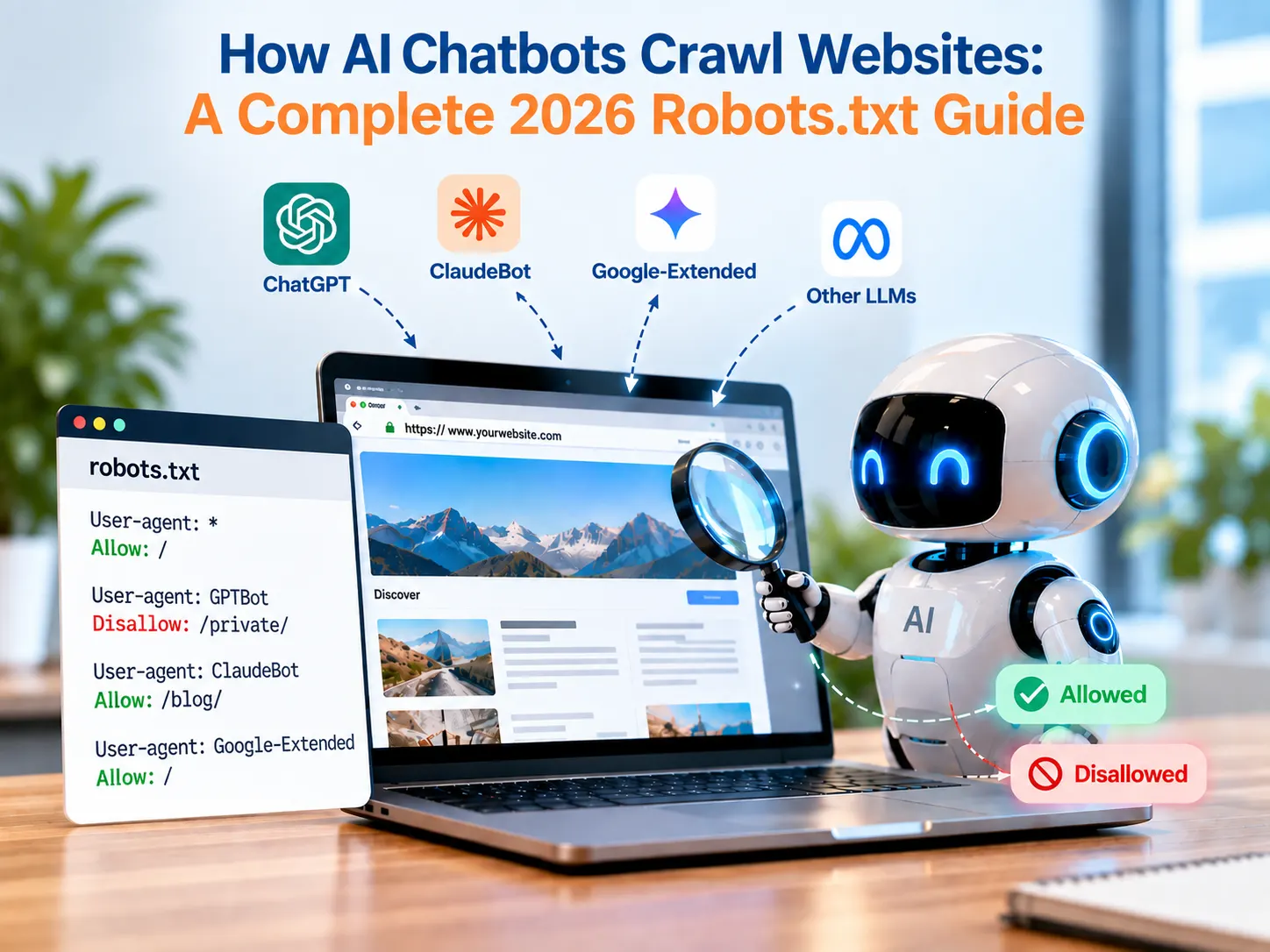
A robots.txt file is a plain text file placed at your domain root, for example, yourdomain.com/robots.txt. It tells visiting bots which parts of your site they are allowed to access. Each rule block starts with a user agent line naming a specific bot, followed by allow or disallow instructions for specific paths.
What robots.txt is used for AI bots in 2026 is fundamentally different from its original purpose. It was designed for search engines like Googlebot, which is permissive by default. If your robots.txt says nothing about Googlebot, Google assumes it can crawl your site. AI bots work the opposite way. Most major AI crawlers expect an explicitly named allow rule. If you have not specifically listed GPTBot, ClaudeBot, or PerplexityBot, some configurations treat that silence as a denial.
How Does ChatGPT Know About My Website: GPTBot vs OAI-SearchBot
This is one of the most common points of confusion. How ChatGPT knows about my website depends on which of OpenAI’s three separate bots reached your pages. OpenAI runs a three-bot system, and each one does a different job.

i. GPTBot
GPTBot crawler rules apply specifically to training. GPTBot fetches your pages to include in the dataset used to train future OpenAI models. Blocking GPTBot stops your content from being used for training. It does not affect whether ChatGPT can cite you in live answers.
ii. OAI-SearchBot
This bot builds the search index that powers ChatGPT Search. OpenAI’s own documentation confirms operators can allow OAI-SearchBot while disallowing GPTBot. This is how most businesses appear in ChatGPT’s cited search answers without contributing to model training.
iii. ChatGPT-User
This bot fetches a specific page the instant a ChatGPT user asks the model to browse or analyze a URL directly. Blocking ChatGPT-User is rarely a good idea, because it breaks a fetch that the user explicitly requested.
Pro Tip: Blocking GPTBot but forgetting ChatGPT-User and OAI-SearchBot is one of the most common mistakes site owners make. These are three separate user agents with separate rules. Check all three explicitly.
AI Crawler vs Search Engine Crawler: The Real Difference
An AI crawler vs search engine crawler comparison comes down to purpose. Googlebot ranks whole pages in a results list. AI crawlers either train a model, build a retrieval index, or fetch a single page on demand for a live chatbot response.
| Search Engine Crawler | AI Crawler |
| Indexes whole pages for ranked search results | Trains models or retrieves content fragments for AI answers |
| Permissive by default unless explicitly blocked | Often requires an explicit named allow rule to access content |
| Example: Googlebot, Bingbot | Example: GPTBot, ClaudeBot, PerplexityBot |
| Outcome is a ranked listing on a results page | Outcome is a citation inside a generated chatbot answer |
| Drives traffic primarily through click-through | Drives brand visibility even without a click |
Cloudflare’s January 2026 analysis showed that Googlebot accessed 1.7 times more unique URLs than ClaudeBot. This confirms that search crawlers still lead in raw crawl volume, even though AI crawler traffic is increasing quickly.
Do AI Chatbots Respect Robots.txt, and Can I Stop AI from Using My Content

Whether AI chatbots respect robots.txt is a fair question. The honest answer is mostly yes. OpenAI, Anthropic, Google, Perplexity, and Apple have agreed to respect robots.txt with their documented crawlers. Google-Extended robots.txt rules let you block Google’s AI from using your content. This way, regular Search indexing remains unaffected.
The exception is Bytespider, ByteDance’s crawler. Reports say it often ignores disallowed rules. Can I stop AI from using my content through robots.txt alone is therefore a qualified yes. Major compliant bots respect your rules. Non-compliant bots need server-level blocking, not just a text file.
How to Block GPTBot in Robots.txt and Other AI Training Crawlers
If you want to stop your content from training AI models but still show up in chatbot answers, this is the setup most businesses will use in 2026.
# Block training crawlers
User-agent: GPTBot
Disallow: /
User-agent: Google-Extended
Disallow: /
User-agent: CCBot
Disallow: /
# Allow live search and retrieval bots
User-agent: OAI-SearchBot
Allow: /
User-agent: ChatGPT-User
Allow: /
User-agent: ClaudeBot
Allow: /
User-agent: PerplexityBot
Allow: /
User-agent: Googlebot
Allow: /
Sitemap: https://yourdomain.com/sitemap.xml
This is how to block GPTBot in robots.txt while keeping your AI search visibility intact. The key principle is to separate training agents from retrieval agents for each major provider. This avoids using one blanket rule for all AI bots.
Best Robots.txt Setup for AI Search Visibility in 2026
If your business needs to be found, set your robots.txt to allow all major search bots. This open approach boosts your AI search visibility. This is typical for marketing agencies, healthcare practices, B2B service providers, and any business that depends on being part of AI-generated answers.
- Add explicit allow rules for GPTBot, OAI-SearchBot, ChatGPT-User, ClaudeBot, PerplexityBot, and Google-Extended.
- Place a Sitemap declaration pointing to your sitemap.xml so AI crawlers can prioritize which pages to fetch.
- Ensure no wildcard user agent rules are above your AI bot allow rules. A blanket disallow rule will silently override everything below it.
- Check your crawl budget using server logs. This helps ensure AI bots get 200 responses, not silent failures.
- Review and update your rules quarterly as new AI crawlers launch.
Why this matters: BrightEdge research showed that server errors made up almost 25% of all ChatGPT user requests on enterprise sites in January 2026. Many businesses are invisible to AI, not by choice, but by a robots.txt configuration nobody reviewed.
Robots.txt Example for ChatGPT and Gemini: A Complete 2026 Template
Here’s a full robots.txt example for ChatGPT and Gemini. It balances generative engine optimization (GEO) visibility with smart training controls, making it ideal for most service businesses in 2026
# OpenAI
User-agent: GPTBot
Allow: /
User-agent: OAI-SearchBot
Allow: /
User-agent: ChatGPT-User
Allow: /
# Anthropic
User-agent: ClaudeBot
Allow: /
User-agent: Claude-User
Allow: /
# Google AI
User-agent: Google-Extended
Allow: /
# Perplexity
User-agent: PerplexityBot
Allow: /
# Standard search engines
User-agent: Googlebot
Allow: /
User-agent: Bingbot
Allow: /
Sitemap: https://yourdomain.com/sitemap.xml
How to optimise a website for AI chatbot answers goes beyond robots.txt alone. Once your crawlers are set up right, your AI search engine can index your content. This depends on having a clear structure and direct answers that AI systems can easily cite.
Is Your Website Visible to AI Chatbots?
Managing AI crawlers correctly ensures your business appears in live AI answers without losing control of your content. A well-set robots.txt file helps balance AI search visibility and protects your training. It stops technical errors from making your site invisible.
For an e-commerce business or local service business, being cited in ChatGPT recommendations is a powerful discovery channel. At Mount Web Technologies, we will audit your robots.txt, fix silent crawler blocks, and optimize your technical SEO. Book your free 30-minute consultation today!
Frequently Asked Questions
Q1. How do AI chatbots crawl websites in 2026?
AI chatbots crawl websites through named bots like GPTBot and ClaudeBot that fetch pages for training, indexing, or live retrieval based on robots.txt rules.
Q2. How do I allow ChatGPT to crawl my website?
To allow ChatGPT to crawl my website, add explicit allow rules for GPTBot, OAI-SearchBot, and ChatGPT-User in your robots.txt file at your domain root.
Q3. Is ChatGPT stealing your website content without permission?
ChatGPT respects robots.txt for its documented crawlers. If GPTBot is allowed, your content can be used for training, but you can block this specifically while staying searchable.
Q4. What is the difference between GPTBot and ChatGPT-User?
GPTBot collects training data for future models. ChatGPT-User fetches a specific page only when a live ChatGPT user asks the model to browse that URL.
Q5. How is AI search changing website traffic patterns?
AI search is changing website traffic. It shifts discovery from clicked links to cited mentions in chatbot answers. Often, this happens without a click back to your site.
Q6. Should I block all AI crawlers from my website entirely?
Blocking all AI crawlers removes you from ChatGPT, Claude, and Perplexity answers entirely. Most businesses benefit more from selective rules than a full block.
Q7. Does Google Extended affect my regular Google Search rankings?
No. Google-Extended robots.txt rules only control Gemini’s AI training access to your content. Your regular Google Search indexing through Googlebot is completely unaffected.
Q8. Why is this 2026 robots.txt guide important for every website owner?
This 2026 robots.txt guide is important. Outdated rules from 2023 and 2024 are quietly blocking AI crawlers that many site owners did not intend to exclude.