Your client’s clinic ranks well on Google. Traffic looks fine. But when their next patient opens ChatGPT or Gemini and asks for a recommendation, a competitor comes up, not your client. This is the AI search optimization problem that most marketing managers did not know they had until 2025.
AI platforms do not use your Google rankings. They send their own bots to read your website directly. If those bots hit a wall, a blocked door, a blank page or content hidden inside JavaScript they move on. They find your competitor instead. In this guide, today we tell you exactly what is happening and how to fix it.
The 2026 Reality: AI Search Is Not Optional
Growing Adoption: Over 50% of U.S. adults now use generative AI tools like ChatGPT and Gemini for research and information gathering. (Source: Pew Research Center)
The Rise of Zero-Click: Nearly 60% of Google searches now end without a click, as AI-generated summaries provide the answer directly on the results page. (Source: SparkToro / Datos)
Explosive Traffic Shift: Referral traffic from AI platforms to brand websites has grown by over 1,000% in the last year alone. (Source: Adobe Digital Insights)
These numbers point to one clear truth in 2026. If AI cannot read your website, you do not exist in AI search. This is not a future problem. It is happening right now for every brand that has not checked how AI bots access its content.
SEO vs GEO vs AEO: The 2026 Framework Explained
The digital marketing world is running three different games at the same time. Understanding the difference is the first step to winning all three.
| Factor | Traditional SEO | AI Search Optimization (GEO / AEO) |
| Goal | Rank on Google results page | Get cited inside AI generated answers |
| Primary Bot | Googlebot (indexer) | GPTBot, ClaudeBot, PerplexityBot (retrieval) |
| Content Signal | Backlinks and keyword density | Structured data, semantic clarity and authority |
| Rendering Need | Can handle JavaScript slowly | Needs pre-rendered server side HTML |
| robots.txt Impact | Block bad bots | Block the wrong AI bots and become invisible |
| Success Metric | SERP position and organic traffic | Brand citation rate in AI answers |
| Schema Markup | Nice to have | Critical for AI to understand content type |
2026 Fact: Google’s own AI Mode now shows AI generated answers for 99.9% of informational queries. If your content is not structured for AI consumption, it will not appear in these answers, even if you rank number one on traditional Google.
Answer Engine Optimization (AEO) is the broad strategy of making your content suitable for direct answers. Generative Engine Optimization (GEO) is its 2024 to 2026 evolution: optimizing specifically for AI based answer generation. AIO optimization refers to the technical side of things, making sure your site structure, server response and schema markup are ready for AI crawlers.
How AI Actually Reads Your Website
This is the section most digital marketing guides skip. Understanding the mechanics changes everything else.
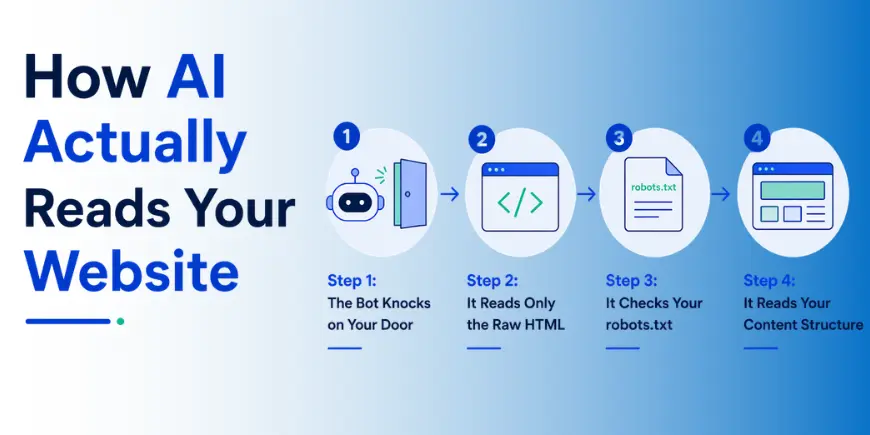
Step 1: The Bot Knocks on Your Door
An AI retrieval bot such as GPTBot (OpenAI), ClaudeBot (Anthropic) or PerplexityBot sends a request to your server and identifies itself. This is where the first problem often appears. If your server or content delivery network rejects that request, the bot gets nothing at all and your brand becomes invisible to that AI platform.
Step 2: It Reads Only the Raw HTML
This is where AI bots work very differently from Google. Google can process JavaScript over time, but AI bots like GPTBot cannot. They only read the raw HTML your server sends.
So if your website is built using React, Angular, or Vue as a Single Page Application, there is a good chance the server is sending almost empty content to AI bots. That means the bot does not actually see your real content, it just sees a blank or incomplete page and moves on.
Step 3: It Checks Your robots.txt
Before they even read your website, AI bots first check your robots.txt file. A very common mistake happens when websites use Cloudflare’s “Block AI Scrapers” feature. It often ends up blocking all AI bots, including the ones used by ChatGPT and Gemini.
The result is simple and immediate. Your brand disappears from AI search because these platforms cannot access your website at all.
Step 4: It Reads Your Content Structure
If the bot can access your content, it reads from top to bottom, paying close attention to key elements that directly impact AI search optimization:
- H1 and H2 headings that help AI understand your main topic and subtopics
- The first 150 to 200 words of each page, which AI often uses to build summaries
- Schema markup in JSON format that explains what type of content your page contains
- Alt text on images, since AI cannot see visuals and depends on descriptions
- Internal link anchor text that helps AI understand how your pages connect to each other
The GEO Technical Checklist: How to Make Your Website AI Friendly
1. Server side rendered HTML
AI bots read only raw HTML from your server. Understanding how AI reads websites is critical because JavaScript-heavy pages often appear empty to them.
2. robots.txt allows GPTBot and ClaudeBot
Before crawling, AI Crawlers / Bots check your robots.txt file. If blocked, your website becomes invisible across platforms like ChatGPT and Gemini instantly.
3. Schema markup (FAQ, Article, LocalBusiness)
Schema markup helps AI understand your content type clearly. It improves visibility in AI Search by making your data structured and easy to interpret.
4. Structured H1 to H3 heading hierarchy
Clear heading structure helps AI scan and extract answers. It plays a key role when running an AI Search Gap Analysis to identify why competitors are being picked over you.
5. Clear author and date metadata
AI systems prioritise trustworthy content. Showing author names and recent updates signals credibility and improves your chances of being selected in AI responses.
6. Descriptive alt text on all images
AI cannot see images, only read text. Adding descriptive alt text ensures your visuals contribute meaningfully to content understanding instead of being ignored.
7. Canonical URLs configured
Canonical tags guide AI to the main version of your content. This prevents duplication issues and ensures accurate indexing across multiple similar URLs.
8. Fast server response under 1 second
Speed directly impacts AI access. Faster websites are easier to crawl, while slow servers often lead to skipped pages or lower prioritisation in AI retrieval.
9. Name, Address and Phone consistency
Consistent business information builds trust. AI relies on matching data across pages to verify your legitimacy, especially for local search recommendations.
10. Answer first opening paragraphs
AI pulls summaries from the first 100 to 200 words. Starting with a direct, clear answer increases your chances of appearing in AI-generated results.
3 Step Manual Framework: Your AI Search Gap Analysis
Before investing in any tool, run this manual audit. It takes under two hours and shows you exactly where you stand in AI search today.
Step 1: Prompt the AI Platforms Directly
Open ChatGPT, Perplexity and Gemini separately. Ask each one the kind of questions your customers would ask as part of your AI search optimization process:
- “What are the best [your service type] providers in [your city]?”
- “Tell me about [your brand name]. What do they do?”
- “Is [your brand name] a good choice for [your main service]?”
What you are measuring: Visibility (do you appear?), Accuracy (is the information correct?), Authority (are you cited as a trusted source?) and Sentiment (is the portrayal positive?). Screenshot every answer. This is your AI Search Gap Analysis baseline.
Step 2: Compare What Your Competitors Are Getting
Run the same prompts for your direct competitors and note:
- Which competitor appears most often in AI answers?
- Which sources is the AI citing? Perplexity shows citations directly so check them.
- Is the competitor using server side rendering? Press Ctrl+U on their page and see if you can read their content in the raw HTML.
- Do they have FAQ or Article schema? Use Google’s Rich Results Test on their URLs to check.
This is how measuring brand sentiment in AI search results works in practice. It tells you not just whether you appear, but why competitors appear instead of you. That gap becomes your action list.
Step 3: Check Your Server Logs
Ask your developer to filter your server access logs by user agent strings. Look for:
- GPTBot: if missing, OpenAI cannot access your content
- ClaudeBot: if missing, Anthropic cannot cite you
- PerplexityBot: if missing, Perplexity has no current data from your site
- Google-Extended: if missing, Gemini is not reading your pages
If none of these appear in the last 90 days, your site is effectively blocked from AI search. This could be caused by your robots.txt file, a Cloudflare security rule or a web application firewall setting.
Content Strategy for AI Search That Drives Visibility
AI retrieval bots reward content that directly answers questions. Here is what that looks like in practice.
Use the Answer First Paragraph Structure
Every key page on your website should open with a 40 to 60 word paragraph that directly answers: “What does this business offer, for whom and where?” AI summarises from the top of the page. If your opening paragraph is a marketing tagline, the AI skips past it entirely.
Use Question Based Headings
Structure your content around the exact questions people ask AI platforms. For example:
- “What does [Your Brand] specialise in?”
- “How does [Your Service] work?”
- “What makes [Your Brand] different from other providers?”
Each of these becomes a direct citation candidate in AI generated answers. This is how to optimize a website for AI in a way that directly improves brand visibility.
Questions AI Mode Users Are Asking Right Now
Based on 2026 Google AI Mode behaviour, these are the questions your pages need to explicitly address:
- Is [brand name] appearing in AI generated answers for my industry?
- Is the AI representing my products and services correctly?
- Is my brand being cited as a trusted source in ChatGPT or Gemini responses?
- Can AI bots actually read my content or is it hidden behind JavaScript?
- Are competitors websites shaping AI answers more than mine?
- What is the difference between traditional SEO rankings and AI search visibility?
2026 Reality Check: The shift is from “How do we rank on Google?” to “Is our brand cited by AI?” These are different problems with different solutions. A site ranked third on Google with poor AI readability will lose to a site ranked eighth with solid GEO implementation, inside AI answers.
Final Words
AI search is no longer an emerging trend, it is already shaping how users discover brands. Understanding how AI reads websites is now critical for visibility. If your site is not structured for AI access, even strong rankings will not help. AI search optimization ensures your content is readable, trusted and actually cited.
At Mount Web Technologies, we help businesses stay ahead with complete GEO (Generative Engine Optimization) and AEO optimization strategies. From technical fixes to content restructuring, we make your website AI ready. Book a strategic call with our team and get a free SEO audit to see exactly where you stand and how to fix it.
Frequently Asked Questions
Q1. What is AI search optimization and is it different from regular SEO?
The difference between AEO and SEO is simple. SEO targets Google rankings. AEO and GEO target AI generated answers on ChatGPT, Gemini and Perplexity. In 2026 you need both.
Q2. How do AI crawlers actually read my website?
Knowing how to optimize websites for AI bots starts here. AI bots fetch raw HTML only. They do not run JavaScript, so dynamic content built in React or Vue is completely invisible to them.
Q3. How do I check if my brand is appearing in ChatGPT or Gemini answers?
Search your brand name and services directly in ChatGPT, Perplexity and Gemini. If you do not appear or the information is wrong, you have an AI Search Gap that needs fixing.
Q4. Does blocking AI bots in robots.txt hurt my brand?
Yes, immediately. Blocking GPTBot or ClaudeBot means those platforms rely on competitor sites and review pages to describe you. You lose control of your brand narrative completely.
Q5. What is the difference between AEO and GEO?
AEO optimizes for featured snippets and voice answers. GEO is its 2024 to 2026 evolution, built for LLM platforms. GEO requires stricter HTML rendering and structured data standards.
Q6. Why does JavaScript hurt AI bot visibility?
Understanding how to make a website AI-friendly means fixing JavaScript first. AI bots do not run browsers. They read raw HTML only, so JavaScript loaded content never reaches them at all.
Q7. How do I know which AI bots are visiting my site?
Filter your server logs by user agent strings. Look for GPTBot, ClaudeBot and PerplexityBot. If none appear in 90 days, something is actively blocking them from your site.
Q8. How long does it take to see results from GEO and AIO optimization?
AIO optimization results vary by platform. Perplexity can reflect changes within days of a successful crawl. ChatGPT may take months. Ongoing monitoring is essential, not a one time fix.