
Quick Summary
- GEO vs SEO is the most important strategic shift in search marketing right now. However, they focus on different surfaces and need unique content strategies.
- Generative Engine Optimization is the practice of structuring content so AI systems like ChatGPT, Perplexity, and Google Gemini cite your brand in their generated answers.
- Traditional Search Engine Optimization still works and remains your foundation. But relying on it alone means you are invisible on platforms that now handle billions of daily queries.
- AI search optimization requires writing for machine extraction. Using verifiable statistics, named sources, and clear headings can boost AI citation rates by as much as 40% (Princeton, 2024).
- GEO strategy and SEO together give you the strongest position across both traditional and AI-powered search surfaces in 2026.
You worked hard to reach page one. You earned the backlinks, optimized the meta titles, and kept your Core Web Vitals clean. But in 2026, something changed. Even with a strong position-one ranking, your organic click-through rate dropped. Why? A Google AI Overview now answers that question above your result. Also, 59.3% of SEO professionals say that algorithm changes due to AI growth are their biggest challenge this year (Medium, March 2026). This is the GEO vs SEO reality playing out in real data, on real sites, right now.
GEO vs SEO is not a debate about which one to pick. It’s about layering them well so your brand stays visible. This works whether a user scrolls through traditional results or looks at an AI-generated answer. Moreover, this guide explains exactly what changed, why it matters, and what to do about it.
What is Traditional SEO and How Does It Work
Search Engine Optimization (SEO) means improving your website. This helps Google and Bing crawl, index, and rank your pages in their organic search results.
It works through four main signals:
- Keyword relevance
- Quality backlinks from trusted sites
- On-page structure, like title tags and headers
- Technical performance, which includes site speed, mobile-friendliness, and crawlability.
The goal is a top-ranked position so users click your link. Traditional SEO still works in 2026 and remains the essential foundation of every search strategy.
What is Generative Engine Optimization and Why It Changes Everything
Generative Engine Optimization means improving your brand and content. The goal is to get cited, recommended, or mentioned in AI-generated answers on platforms like ChatGPT, Gemini, Perplexity, and Claude. You may also hear it called LLM optimization or AI search optimization. All three describe the same shift. The goal is not a ranked link on a results page.
The goal is inclusion in the AI’s synthesized response at the exact moment a buyer is making a decision. When someone asks ChatGPT which SEO agency to hire or prompts Perplexity to compare marketing platforms, there are no ten blue links. There is one consolidated answer. If your brand is not in it, you do not exist for that user at that moment.
GEO vs SEO: The Core Difference Explained with Real Examples
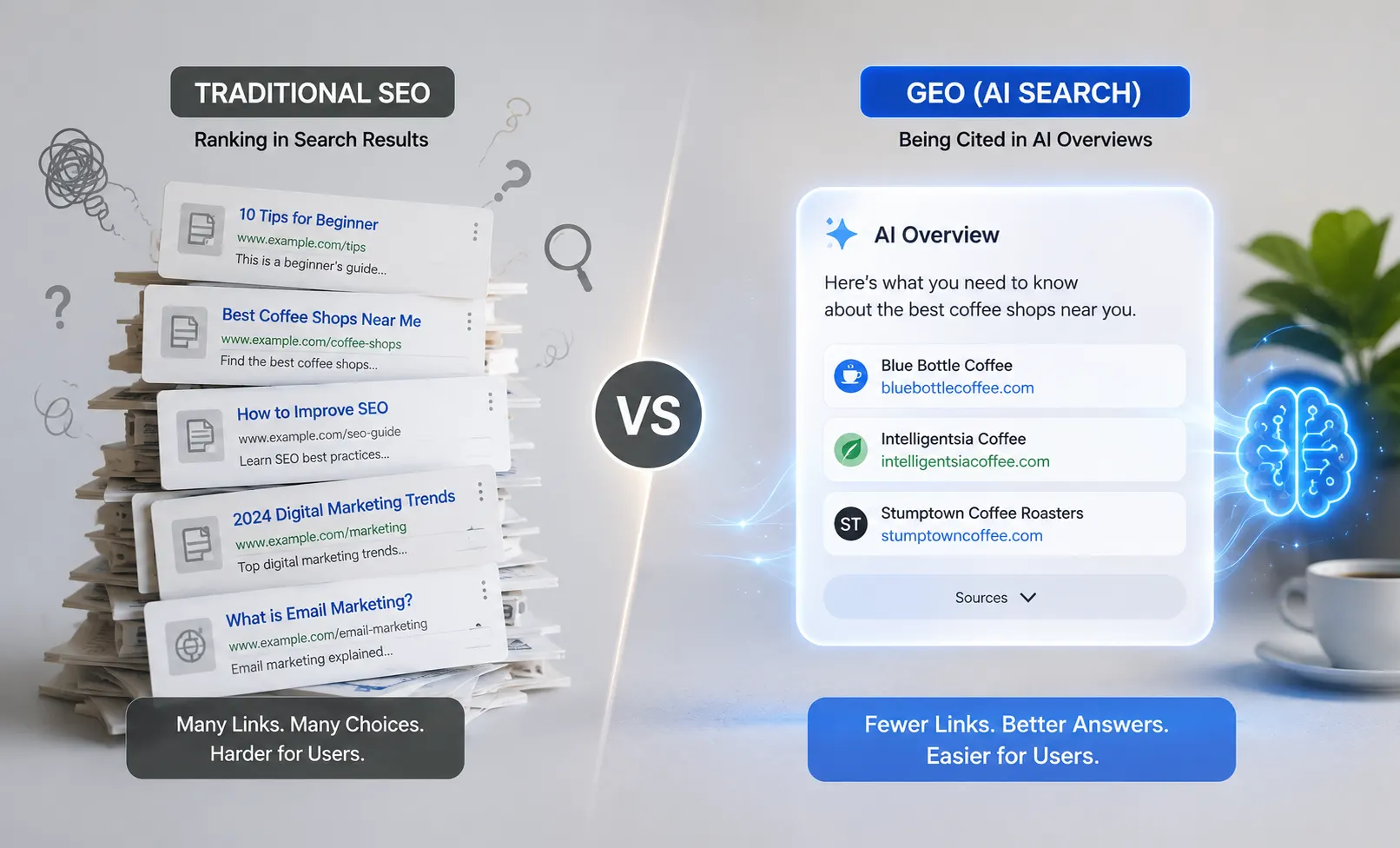
The difference between SEO and GEO, explained simply, comes down to what you are optimizing for. Traditional Search Engine Optimization targets a ranked position in a list of links. Generative Engine Optimization focuses on a citation within an AI-generated answer that doesn’t include any list.
| Traditional SEO | Generative Engine Optimization (GEO) |
| Targets ranked links in Google search results | Targets citations inside AI-generated answers |
| Success measured by click-through rate and rankings | Success measured by AI citation frequency and brand mentions |
| Optimizes for keyword matching and backlink authority | Optimizes for information density and source verifiability |
| Works on Google, Bing, and traditional search result pages | Works on ChatGPT, Gemini, Perplexity, Claude, and Copilot |
| Content structured for human readability and keyword placement | Content structured for AI extraction and citation eligibility |
GEO vs SEO example: In 2022, a user searched “best blue jeans for men” on Google and clicked a website link. In 2026, the same user asks ChatGPT the same question and gets a direct answer with a few recommended brands. With SEO, you win when users click your website. With GEO, you win when your brand is included in the AI-generated answer.
How AI Answer Engines Choose What to Cite
AI answer engines find and combine relevant information from multiple sources. Effective AI search optimization helps content get selected and cited in AI-generated responses.
- AI analyzes the user’s question and searches for the most relevant content fragments.
- Strong LLM optimization makes content easier for AI systems to understand, retrieve, and reference.
- Clear, direct answers are more likely to be extracted than long, unfocused content.
- AI often cites specific paragraphs instead of ranking entire webpages.
Clear and structured answers boost AI visibility and raise the chances of appearing in AI-generated results.
Is GEO Replacing SEO? What the 2026 Data Actually Says
The data confirms that Generative Engine Optimization (GEO) is not fully replacing traditional methods, but their integration is now mandatory.
- The Decline: According to data published by Gartner, traditional search engine volume will drop 25% by 2026 due to the rapid rise of AI answer features.
- The Long-Term Impact: A separate study via Gartner’s Marketing Practice forecasts a 50% drop in organic website traffic by 2028 as users embrace conversational AI interfaces.
While standard search engine optimization still secures foundational web indexation, it no longer functions as a standalone strategy. Brands that use a unified framework for both traditional indexing and large language model algorithms do better than those that rely on just one method.
How Generative Engine Optimization Works and How GEO Differs from Traditional SEO
Both disciplines control how AI and search engines find your brand. Here is exactly how each one operates under the hood.
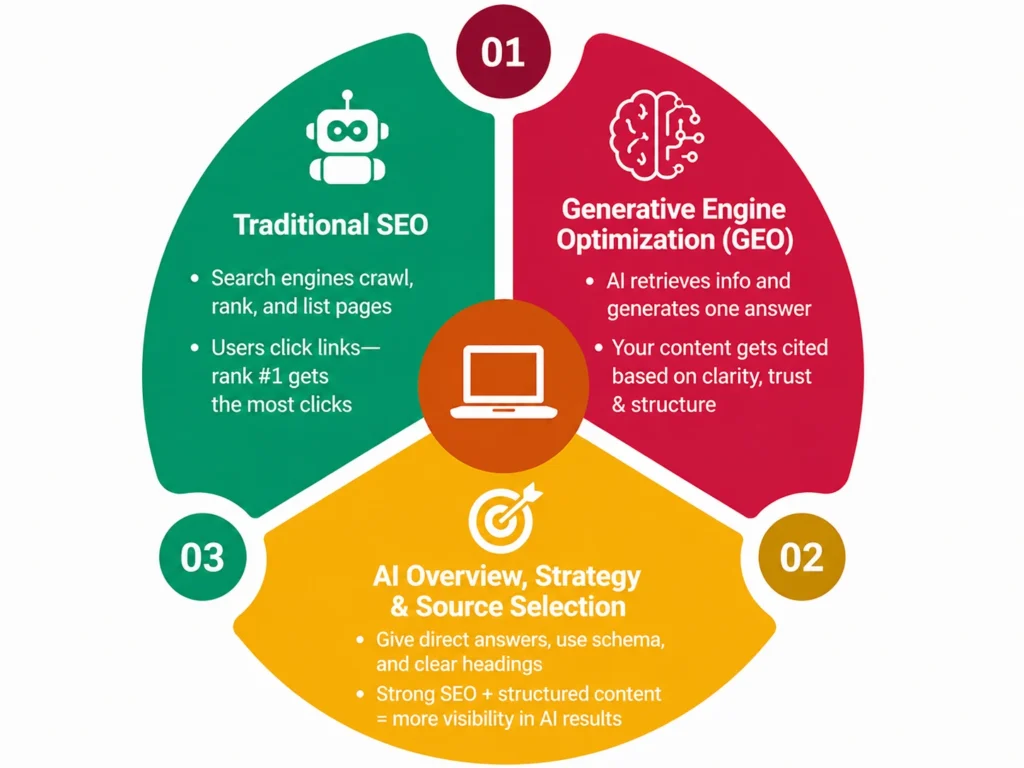
1. How Traditional SEO Works
- Googlebot crawls your pages, follows links, and downloads content into Google’s index
- The algorithm ranks indexed pages using keyword relevance, backlink authority, and page experience signals
- Users see a ranked list of ten links and click through to visit websites
- Position one earns the most clicks. Everything below the fold competes for what remains
- Winning requires strong on-page optimization, technical SEO, SEO maintenance, and consistent link building over time
2. How Generative Engine Optimization Works
- AI platforms use Retrieval Augmented Generation: they retrieve relevant content fragments, then synthesize a single answer
- Large Language Model content evaluation assesses factual density, source credibility, and semantic relationships rather than keyword frequency
- A well-structured paragraph answering a specific question can earn an AI citation even without a top-ten Google ranking
- There is no ranked list. The AI delivers one consolidated response and attributes the sources it drew from
- To win, provide clear opening answers for each heading. Include named citations that can be verified. Also, use thorough schema markup throughout.
3. AI Overview, Strategy, and Source Selection
Effective LLM optimization requires structuring your content so each section acts as a standalone answer. Google AI Overview chooses sources based on top organic rankings. So, a strong AI Overview strategy combines traditional methods with machine learning.
- Direct Answers: Provide the core solution in the first two sentences beneath your headings.
- Schema Markup: Implement complete JSON-LD structured data to help neural networks parse your pages.
- Clear Hierarchy: Use targeted headers and robust trust signals so engines can easily extract citation-worthy passages.
How to Rank in ChatGPT and Gemini Results: A Practical GEO Strategy
To rank in ChatGPT and Gemini, you need to know that each uses its own ranking logic. GEO for ChatGPT and Google AI Overviews is not a single strategy. It is a platform-aware approach.
ChatGPT favors domain reputation and information density. Maximize data points per paragraph, use a clear heading hierarchy, and ensure AI crawlers like GPTBot can access your pages. Gemini uses Google’s usual ranking signals. This means that pages not ranking organically won’t be cited by Gemini. For Perplexity, every claim must be verifiable and sourced. Perplexity is a citation-first engine. It links every fact to a specific source. This makes it the most measurable GEO platform for tracking progress.
How to Optimize Content for AI-Generated Answers Without Rebuilding Your Site
Optimizing content for AI-generated answers does not mean starting from zero. Most businesses have existing content that ranks but does not earn AI citations. The fix is structural, not topical. These are the changes that consistently move the needle.
- Rewrite each H2 heading as a direct question that mirrors how your audience phrases queries to AI tools
- Place a sourced statistic or verifiable data point within the first 100 words of every page section
- Add the FAQ schema, Article schema, and Organization schema using JSON-LD on every key page
- Include a named author with verifiable credentials on every informational blog post
- Write a self-contained answer in the first two sentences of every section so AI can extract it without context
- Check that GPTBot and PerplexityBot are not blocked in your robots.txt file
GEO vs SEO, which is better for 2026, is answered by how well you execute both together. EarnSEO’s analysis of 150,000 pages showed that content ranking high in Google doesn’t always get cited by AI. You can measure the gap between SEO and GEO performance. With planned structural changes to your content, you can close this gap.
Find Out Where Your Brand Stands in AI Search
At Mount Web Technologies, we help businesses in the USA and across global markets build search strategies that perform on both traditional and AI-powered platforms. We focus on technical SEO, schema implementation, GEO strategy, and AI citation monitoring. Our work is designed for how search operates in 2026.
We’ll check your GEO and SEO visibility. Then, we’ll find out which AI platforms are citing your competitors instead of you. Finally, we’ll create a clear plan to close that gap. Book your free strategy session.
Frequently Asked Questions
Q1. What is the main difference in GEO vs SEO for 2026?
GEO vs SEO comes down to the target surface. SEO wins ranked links. GEO wins citations inside AI-generated answers on ChatGPT, Gemini, and Perplexity.
Q2. Is GEO replacing SEO in 2026?
Is GEO replacing SEO a false choice? Traditional SEO remains your foundation. GEO adds the AI visibility layer that SEO alone can no longer provide.
Q3. How does Generative Engine Optimization work?
Generative Engine Optimization helps structure content. This way, AI retrieval systems pick your page and create a response that mentions your brand.
Q4. What does GEO mean in digital marketing?
GEO in digital marketing means optimizing content to gain citations in AI-generated answers, not just in traditional Google search rankings.
Q5. How do I optimize content for AI-generated answers?
To improve AI-generated answers, start with sourced statistics in your opening paragraph. Then, rewrite headings as questions. Also, include JSON-LD schema throughout.
Q6. How does GEO differ from traditional SEO technically?
GEO differs from traditional SEO because LLMs look at meaning and factual density instead of just keyword frequency. This means content needs to be approached differently.
Q7. How do I rank in ChatGPT and Gemini results?
To rank in ChatGPT and Gemini results, build domain authority for Gemini, and maximize information density with named source citations for ChatGPT.
Q8. What are E-E-A-T signals for AI search ranking?
E-E-A-T signals for AI search ranking include the following:
- Named expert authors
- Verifiably sourced statistics
- External citations linking to your content
- Consistent brand entity recognition
Q9. How does Google AI Overview choose which sources to cite?
Google AI Overview chooses sources based on the following:
- Organic rankings
- Completeness of structured data
- Placement of direct answers
- Strong E-E-A-T signals on the page
Q10. What is an AI Overview strategy for SEO?
An AI Overview strategy combines strong organic rankings with FAQ schema, direct opening answers, and question-based headings that match exactly how users query AI tools.
Q11. Does traditional SEO still work in 2026?
Traditional SEO still works in 2026 for branded and transactional queries. It remains the necessary foundation but requires GEO layered on top for full search visibility.
Q12. What is LLM optimization, and why does it matter?
LLM optimization structures content so that large language models can extract, verify, and cite individual sections independently, increasing AI citation frequency across all platforms.