
Quick Summary
- Generative Engine Optimization is the practice of structuring your content so AI platforms like ChatGPT, Perplexity, and Google Gemini cite your brand when answering user questions.
- GEO vs SEO is not a competition. SEO wins ranked links. GEO wins citations inside AI-synthesized answers. You need both in 2026.
- LLM optimization requires writing for machine extraction, not just human readers. Direct answers, verifiable statistics, and named source citations drive citation rates up to 40% higher (Princeton, 2024).
- AI visibility is already measurable. AI-referred sessions jumped 527% year over year in 2025, and ChatGPT converts at 14 to 16% compared to traditional organic at 2 to 3%.
- GEO strategy built on topical authority, structured data, and E-E-A-T signals consistently outperforms content that relies on keywords alone when measured against AI citation frequency.
- This guide features real case studies that reveal which content types get the most AI citations. It also explores what the future of SEO with AI search holds for businesses that take action now.
You have published the blog posts, built the backlinks, and held strong rankings on Google for years. But when a potential customer opens ChatGPT and asks which agency they should hire, or which product they should buy, your name does not appear. Your competitor does. This is happening millions of times a day in 2026, and it is not a traffic problem. It is a Generative Engine Optimization problem.
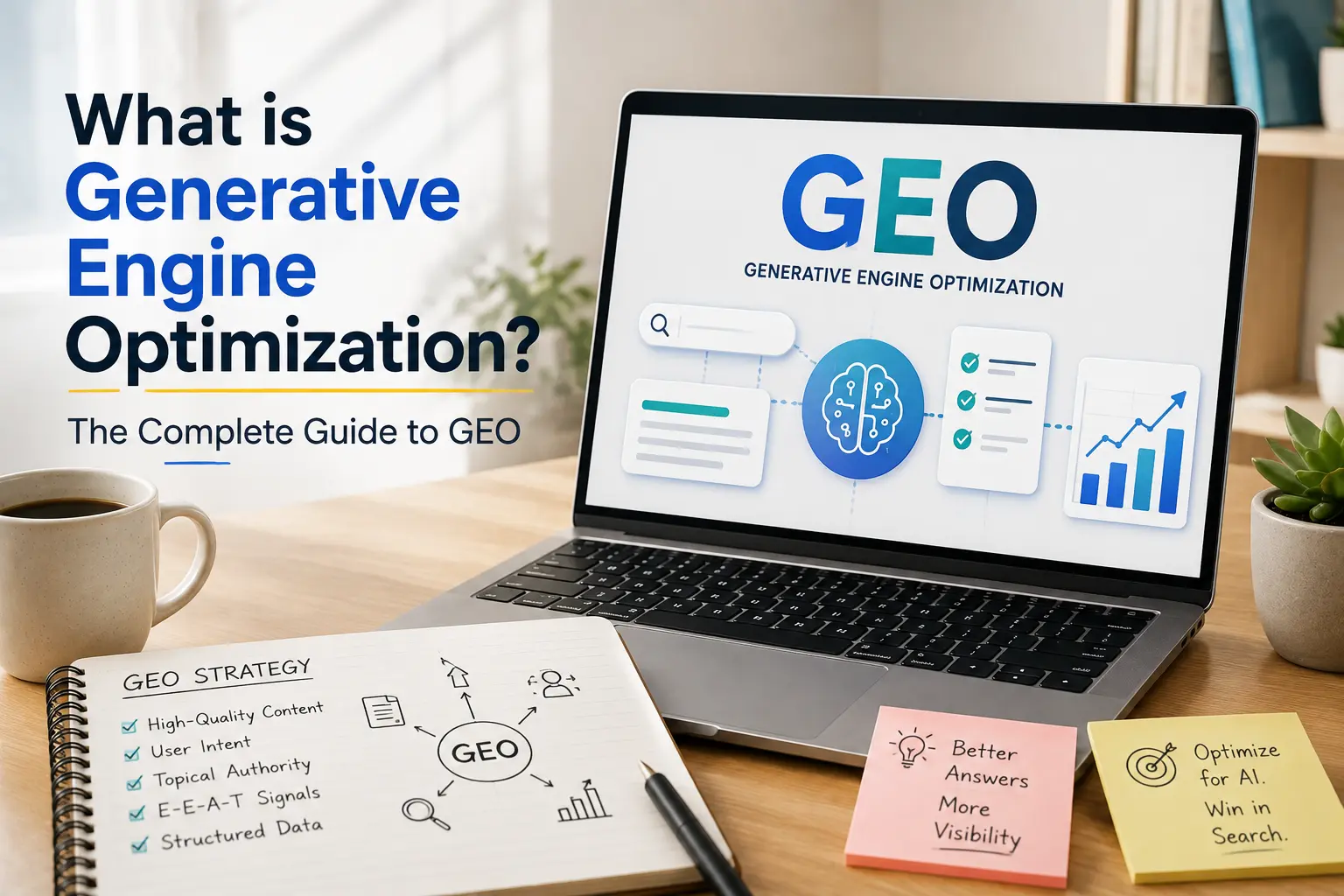
Generative Engine Optimization (GEO) focuses on organizing and sharing content. This helps AI search platforms mention your brand in their responses. It is the most important new layer of digital marketing in a decade, and most businesses have not started yet.
This guide explains what GEO is and how Generative Engine Optimization works. It highlights how GEO differs from traditional SEO. You’ll also find specific strategies to earn citations in ChatGPT, Perplexity, Google Gemini, and Claude in 2026.
What is Generative Engine Optimization and How Does It Work
Generative Engine Optimization means improving your content so that large language models can find and cite it when answering user questions. Traditional SEO targets a ranked list of links. GEO targets inclusion inside the AI-synthesized answer itself before the user ever sees a link.
AI platforms like ChatGPT and Perplexity first find relevant content, then use it to generate answers. To earn citations, your content must be discoverable, credible, and clearly structured.
Why this matters right now: ChatGPT captures 18% of all web queries (Similarweb, 2026). Sites without GEO optimization lost 29% visibility in Perplexity tests (BizAI, 2026). AI-referred sessions grew 527% year over year in 2025 (Previsible). And ChatGPT converts at 14 to 16% compared to typical organic traffic at 2 to 3%.
GEO vs SEO: What Is the Real Difference and Which One Do You Need
Traditional SEO optimizes for Google’s algorithm to rank your page in position one of a results list. GEO optimizes AI search by improving how an AI retrieves and cites information. This way, your content becomes the source that AI quotes when it creates answers.
| Traditional SEO | Generative Engine Optimization (GEO) |
| Targets ranked links in Google results | Targets citations inside AI-generated answers |
| Optimizes for keyword matching and backlinks | Optimizes for information density and source credibility |
| Measures success through click-through rate and rankings | Measures success through AI citation frequency and brand mentions |
| Works on Google and Bing search result pages | Works on ChatGPT, Perplexity, Gemini, Claude, and Copilot |
| Content written to satisfy keyword intent | Content written to be extracted as a verifiable standalone answer |
| Traffic declines when AI Overviews appear above results | Traffic grows as AI systems cite your content in their answers |
Gartner predicts traditional search volume will drop 25% by 2026, with organic traffic to commercial pages falling 50% by 2028. Even Google Discover traffic, once a reliable source of passive visibility, is being reshaped by the same AI-driven discovery shift. That is not a reason to abandon SEO. It is a reason to add GEO on top of your existing SEO foundation before that decline accelerates.
How to Rank in ChatGPT, Perplexity, and Google AI Overviews: The Core GEO Strategy
Each AI platform has a distinct ranking logic, and a smart GEO strategy accounts for each one. Understanding the difference is what separates brands that appear consistently across AI answers from those that appear occasionally and cannot explain why.
1. How to Optimize for ChatGPT
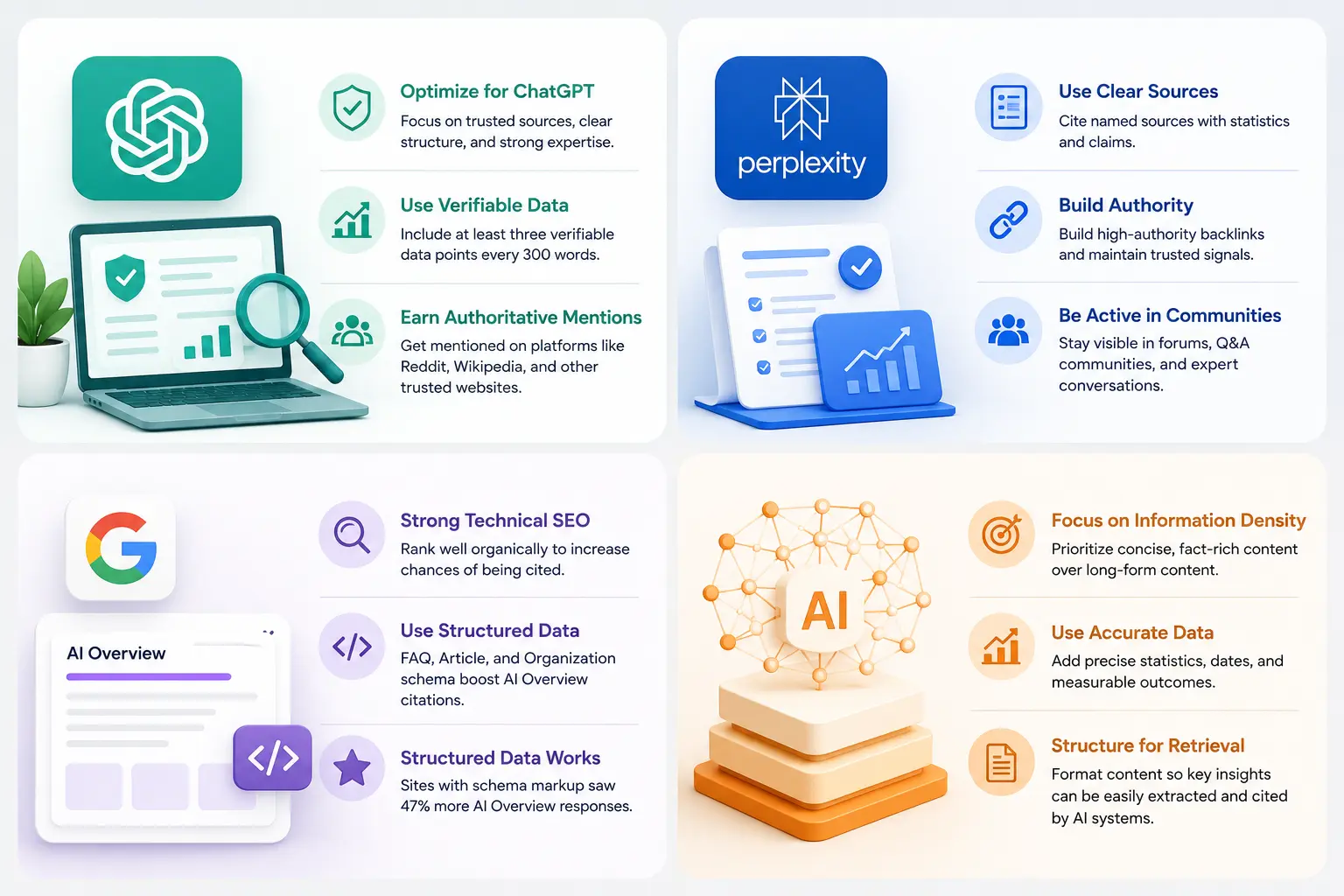
ChatGPT focuses on trusted sources and strong expertise. It values clear and well-organized content. This approach helps boost credibility, clarity, and accessibility, which are key for better AI search visibility.
- Include at least three verifiable data points every 300 words to strengthen authority and increase citation potential.
- Use a logical H2 and H3 heading structure to improve readability and AI content extraction.
- Keep content information-dense with concise, fact-focused paragraphs that answer user intent quickly.
- Ensure pages are fully crawlable and accessible to AI agents and search engine bots.
- Earn mentions on authoritative platforms such as Reddit, Wikipedia, and industry reference websites.
Brands that combine reliable content, clear formatting, and strong third-party mentions are more likely to appear in AI-generated responses.
2. How to Optimize for Perplexity
Perplexity values clear sourcing. It rewards content that offers credible, verifiable information. This information must be backed by trusted references and independently verified evidence.
- Include named sources alongside statistics and claims.
- Build high-authority backlinks to strengthen trust signals.
- Create data-rich sections that function as standalone references.
- Maintain visibility across industry forums and Q&A communities.
Community-driven platforms produce many AI citations. So, external mentions and expert talks are key for boosting Perplexity’s citation chances.
3. How to Optimize for Google AI Overviews and Gemini
GEO for ChatGPT and Google AI Overviews requires different foundations. Gemini inherits Google’s traditional ranking signals, which means strong technical SEO is a prerequisite for Gemini visibility. If your page does not rank well organically, it is unlikely to be cited by Gemini. For Google AI Overviews specifically, structured data is critical.
Sites with detailed JSON-LD schema markup showed 47% more AI Overview responses compared to unstructured sites. Using FAQ schema, Article schema, and Organization schema boosts AI Overview citation rates.
4. LLM Optimization Through Retrieval-Augmented Generation SEO
Retrieval-augmented generation SEO focuses on helping AI systems identify, retrieve, and cite the most valuable content through clear structure and verifiable information.
- Prioritize information density over content length.
- Use precise statistics, dates, and measurable outcomes.
- Support claims with credible sources and evidence.
- Structure content so key insights can be extracted as standalone passages.
AI retrieval systems prefer clear, accurate statements backed by evidence. This focus on clarity and verifiability boosts citation potential and visibility for LLMs.
E-E-A-T for AI Search: Why Trustworthiness Decides Who Gets Cited
The concept of E-E-A-T for AI search extends Google’s original quality framework into the AI citation context. Experience, Expertise, Authoritativeness, and Trustworthiness aren’t just factors for Google’s quality assessments. They are the signals AI systems use to evaluate whether your content is safe to cite in front of millions of users.
An AI system won’t cite a page without author credentials, unverifiable claims, or from a low-recognition domain.
An AI citation strategy based on true E-E-A-T involves the following:
- Publishing content by named expert authors.
- Supporting major claims with sourced statistics.
- Gaining mentions from .gov and .edu domains.
- Creating an entity presence that AI systems can verify across various sources.
The Princeton University study on GEO found that:
- Adding quotations raised AI citation rates by 41%.
- Adding statistics boosted rates by 32%.
- Citing sources increased rates by 30%.
These are not stylistic choices. They are signals that AI systems are trained to reward.
Real Example:
A B2B SaaS company published a comparison guide covering five competing tools. The guide had sourced statistics in each section, an author with verified credentials, and an FAQ schema for every question-based heading. In just six weeks, the page was mentioned in ChatGPT answers for 14 different queries.
AI search had grown to 4.5% of total organic traffic for B2B SaaS sites by September 2025, with 127% growth in three months (Previsible). Comparison content earns 32.5% of all AI citations across platforms, making it the highest-performing content type for GEO.
AI Visibility Optimization: The Content Formats That Earn the Most Citations
Not all content earns equal AI visibility. Research on AI citation patterns shows a clear hierarchy of content types. Building your GEO strategy around these formats leads to higher citation frequency.
- Comparison articles earn 32.5% of all AI citations and consistently outperform all other content formats (Previsible, 2026)
- Original research and data with named sources earn citations at rates up to 40% higher than general content (Princeton, 2024)
- Best-of guides and product comparisons drive the most AI referral traffic, according to Previsible’s AI Traffic Report.
- FAQ-style content matches how users ask questions to AI. This leads to high citation rates in both ChatGPT and Google AI Overviews.
- Case studies with specific outcomes get cited because AI systems favor verifiable, outcome-led claims over generic assertions.
Pro Tip: Place your most compelling statistic within the first 200 words of every page. This is the zone AI systems scan first during the RAG retrieval step. A strong data point in the opening paragraph signals credibility before the AI reads the rest of the content.
Why Your Content Is Invisible to AI and How to Fix It
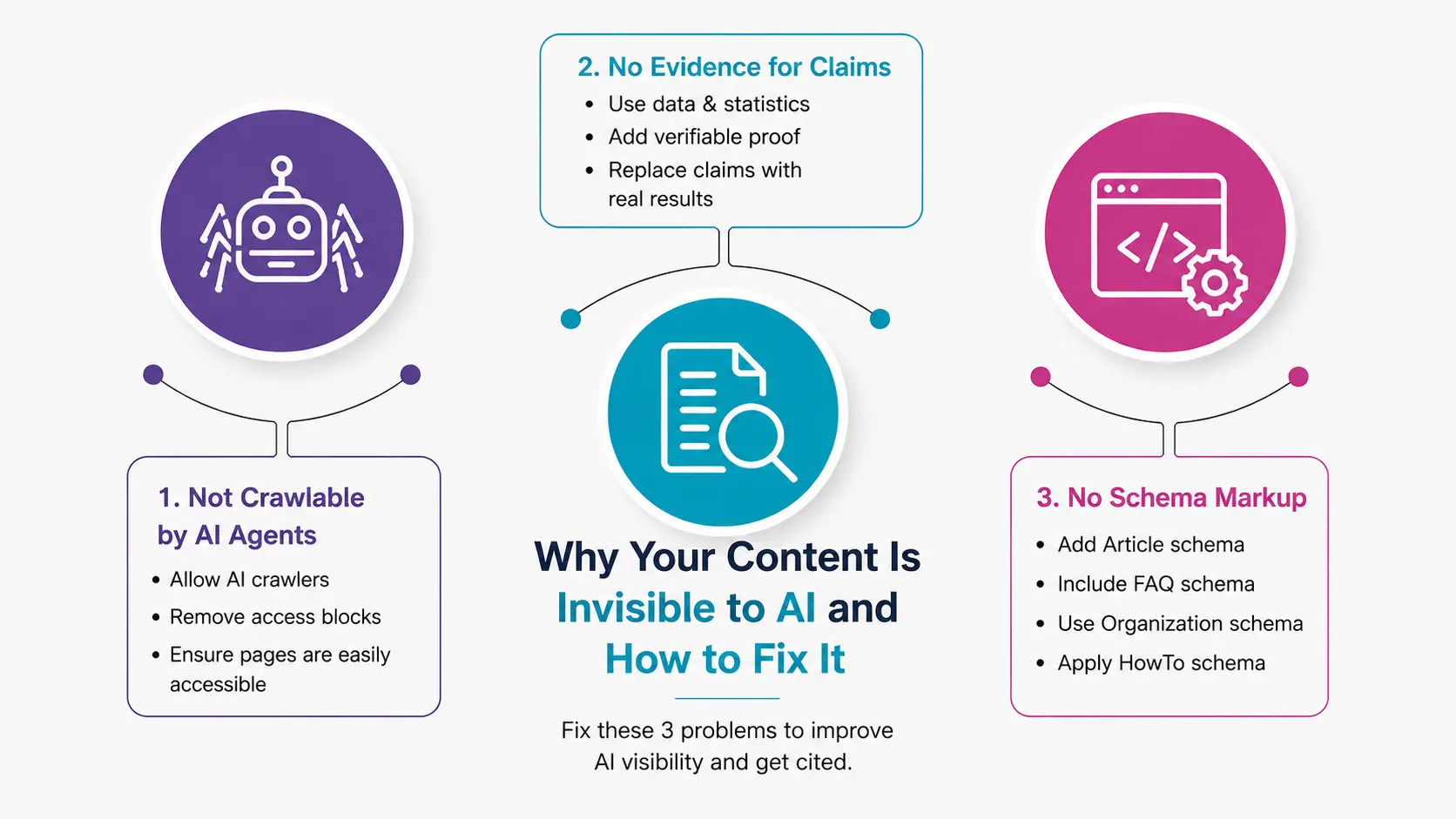
Why your content is invisible to AI usually comes down to one of four structural problems. Identifying which one applies to your site is the fastest way to start improving AI visibility without rebuilding everything from scratch.
1. Problem One: Your Content Is Not Crawlable by AI Agents
AI systems build their retrieval indices by crawling the web. If your pages are blocked by robots.txt, behind login walls, or only visible via JavaScript that AI crawlers can’t access, they won’t appear in AI answers, no matter how great the content is. The first step in any GEO strategy is to confirm that AI crawler agents, like GPTBot, PerplexityBot, and GoogleBot, can access your key pages.
2. Problem Two: Your Content Makes Claims Without Evidence
AI systems are trained to cite credible sources. A page that says “we are the best agency in the industry” provides nothing an AI can verify or quote. A page that says, “Our clients saw 43% more organic traffic in 90 days, verified by GA4,” gives the AI a strong, reliable claim to use in its response. Replace general assertions with specific, verifiable outcomes throughout your content.
3. Problem Three: You Have No Schema Markup
Structured data tells AI systems exactly what your content is and how to categorize it. Pages without JSON-LD schema markup miss a significant citation advantage.
- Add Article schema to each blog post.
- Include FAQ schema for all question-and-answer sections.
- Use the Organization schema on your homepage.
- Apply the HowTo schema to any process or guide content.
This directly improves how to get cited by AI search engines in practice.
GEO Is the New SEO for 2026: How to Future-Proof Your Search Presence
The future of SEO with AI search is not a replacement for what already works. It is an expansion of where visibility is earned. SEO keeps your pages ranking in the traditional index. GEO makes sure your content is also present inside the AI-generated answers that now appear above those rankings. GEO is the new SEO for 2026. It’s the key for brands that want to stay visible as users increasingly turn to conversational AI.
AI search is rapidly reshaping online visibility. As AI-driven discovery grows, brands investing in Generative Engine Optimization today can build lasting citation authority and gain a competitive advantage that becomes harder to overcome over time.
Generative AI search optimization starts with an audit of your current AI visibility. Which queries in your niche are generating AI answers? Is your brand cited in any of them? Which competitors are showing up where you are not? These questions highlight the gap. A structured GEO strategy aims to close that gap step by step.
Ready to Get Your Brand Cited by AI?
At Mount Web Technologies, we build AI visibility strategies for businesses across the USA and globally. We focus on content restructuring, schema implementation, and building topical authority. We also monitor AI citations. Our approach is built for how search works in 2026, not how it did three years ago.
We will check your AI visibility. Then, we’ll find out which queries your competitors excel in on ChatGPT and Perplexity. Finally, we’ll create a GEO roadmap to position your brand in the answers your customers are already seeing. Book a FREE strategy session today.
Frequently Asked Questions
Q1. What is Generative Engine Optimization, and how does it work?
Generative Engine Optimization arranges your content. This helps AI systems, like ChatGPT and Perplexity, find and cite it when users ask questions on different platforms.
Q2. What is the difference between SEO and GEO, explained simply?
SEO focuses on getting ranked links, while GEO secures citations in AI-generated answers that users see before clicking.
Q3. How do I rank in ChatGPT and Perplexity results?
To rank in ChatGPT and Perplexity results, publish content that is rich in data. Use named source citations, strong E-E-A-T signals, and clear, structured headings. This helps AI extract information easily.
Q4. What does GEO mean in digital marketing?
GEO in digital marketing means optimizing your content and technical setup. The goal is to earn citations in AI-generated answers, not just in traditional search rankings.
Q5. Is GEO better than SEO for 2026?
GEO vs SEO, which is better, is the wrong question. Both are needed. SEO builds your organic foundation while GEO earns visibility inside AI-generated answers your audience already trusts.
Q6. How does Answer Engine Optimization relate to GEO?
Answer Engine Optimization targets short, direct answers in featured snippets and voice results. GEO targets citations inside full AI-synthesized responses across ChatGPT, Perplexity, and Gemini.
Q7. What is an AI citation strategy, and why does it matter?
An AI citation strategy is a clear plan. It makes your content easy to verify and well-structured. This way, AI systems can confidently quote it when providing answers for users.
Q8. How does LLM optimization differ from traditional content writing?
LLM optimization focuses on information density, direct answers, and verifiable claims. This approach helps AI models extract and cite your content reliably, instead of just relying on keyword placement.
Q9. What role does retrieval-augmented generation SEO play in GEO?
Retrieval-augmented generation SEO means structuring content so the AI retrieval step selects your page before the generation step begins, putting you in the citation pool first.
Q10. How do I get cited by AI search engines like ChatGPT?
To be cited by AI search engines, follow these steps:
- Include verifiable statistics with named sources in the first 200 words.
- Use JSON-LD schema.
- Write clear answers under each heading.
Q11. What is the complete guide to Generative Engine Optimization for beginners?
The complete guide to Generative Engine Optimization for beginners starts with four steps: make content crawlable, add named citations, implement schema markup, and write direct answers first.
Q12. How is AI changing Google search in 2026?
How AI is changing Google search is visible in the data. AI Overviews appear in 25 to 40% of queries, and organic CTR dropped 61% on pages where an AI Overview is shown.