What You Will Learn
- Why Google AI Overviews now appear in 48% of all tracked searches and what that number really means for your traffic.
- The exact difference between SEO and Answer Engine Optimization and why both matter in 2026.
- How AI Overview ranking factors decide which content gets cited and which gets ignored.
- The best SEO and AEO strategies for businesses to stay visible in AI-powered search engines.
- Why ChatGPT SEO optimization and voice search optimization are no longer optional add-ons.
- A clear action checklist to rank in AI answers before your competitors do.
Search has changed more in the last twelve months than in the previous ten years combined. If your website is still optimized for the old model of search, you are losing ground right now. Google AI Overviews have grown 58% year over year and now trigger on 48% of all tracked search queries as of early 2026, according to BrightEdge data. That is not a slow shift. It is a complete rewiring of how your audience finds information.
This is where the debate around SEO vs AEO 2026 becomes critical for every business owner and marketer. Understanding both, and knowing how to use them together, is the difference between growing traffic and watching it disappear into an AI summary box. Let’s deep dive!
SEO vs AEO 2026: What Has Actually Changed and Why It Matters
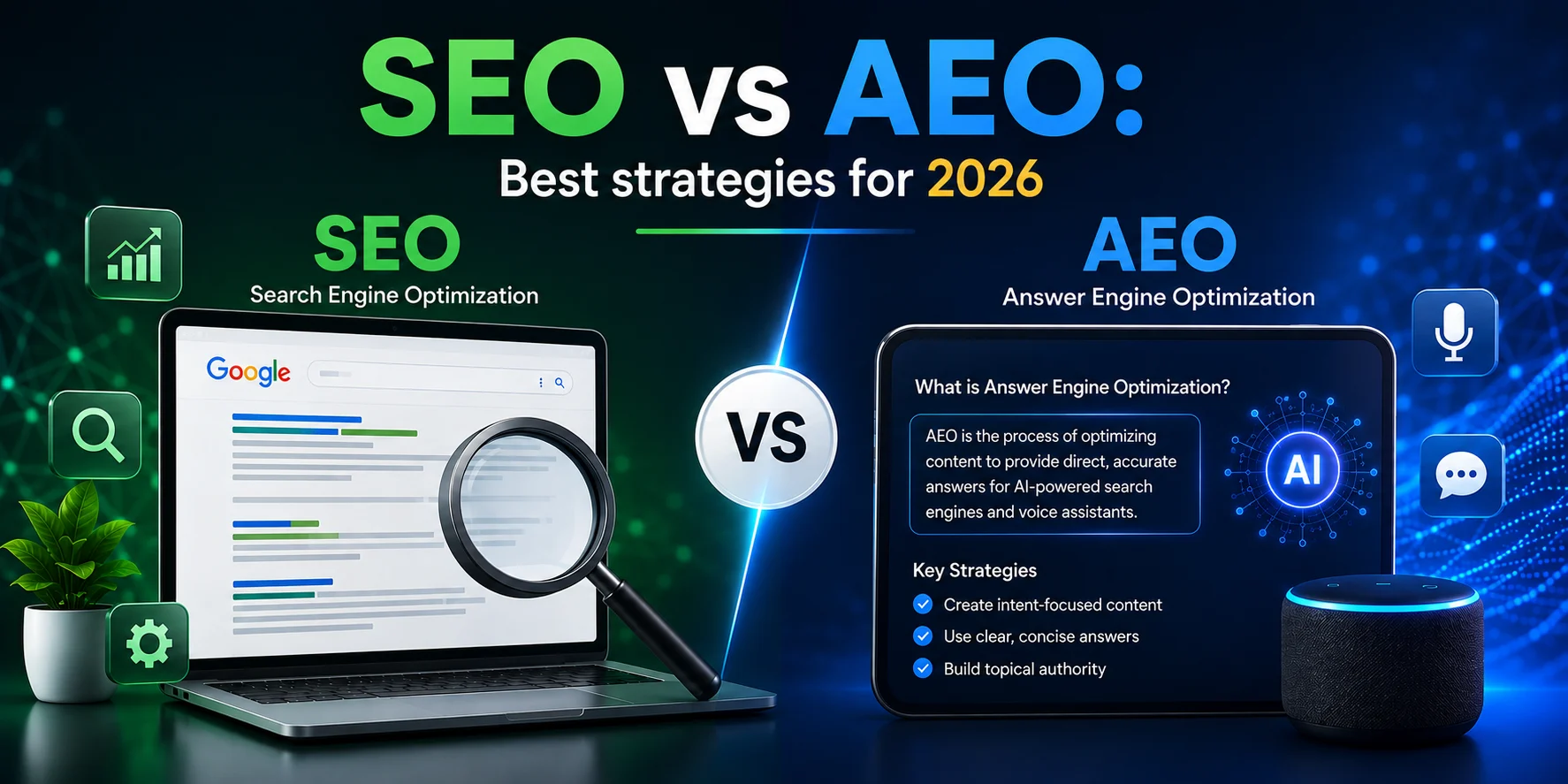
Traditional SEO was built around getting your page to rank in position one. Answer Engine Optimization, or AEO, is about getting your content cited directly inside the AI-generated answer. These are two different goals and they require two different strategies.
The future of SEO in 2026 is not about choosing one over the other. It is about understanding that Google, ChatGPT, Perplexity, and other AI-powered search engines now operate as answer machines. They summarize the best available information and present it without necessarily sending users to your website. If your content is not structured to feed these systems, you simply will not exist in their answers.
| SEO (Search Engine Optimization) | AEO (Answer Engine Optimization) |
| Targets keyword rankings on search result pages | Targets citations inside AI-generated answer boxes |
| Optimizes for clicks and page visits | Optimizes for being the source AI engines quote |
| Focuses on backlinks and domain authority | Focuses on content depth, clarity, and structured data |
| Works primarily on Google and Bing | Works across Google, ChatGPT, Perplexity, and Gemini |
| Measures success through organic traffic | Measures success through AI citation frequency and brand visibility |
The difference between Search Engine Optimization and Answer Engine Optimization is not just technical. It is strategic. SEO builds your floor. AEO builds your ceiling in the new search landscape.
How AEO Works and Why AI-Powered Search Engines Prefer Certain Content
Understanding how AEO works starts with understanding how AI reads your content. These systems do not rank pages the way a traditional algorithm does. They scan for content that directly, clearly, and confidently answers a question. If your page buries the answer under three paragraphs of background, the AI moves to a competitor who answered it in the first sentence.
 AI-powered search engines use natural language processing to identify the most trustworthy, well-structured, and contextually complete answer available. This is what makes NLP optimization central to any 2026 content strategy.
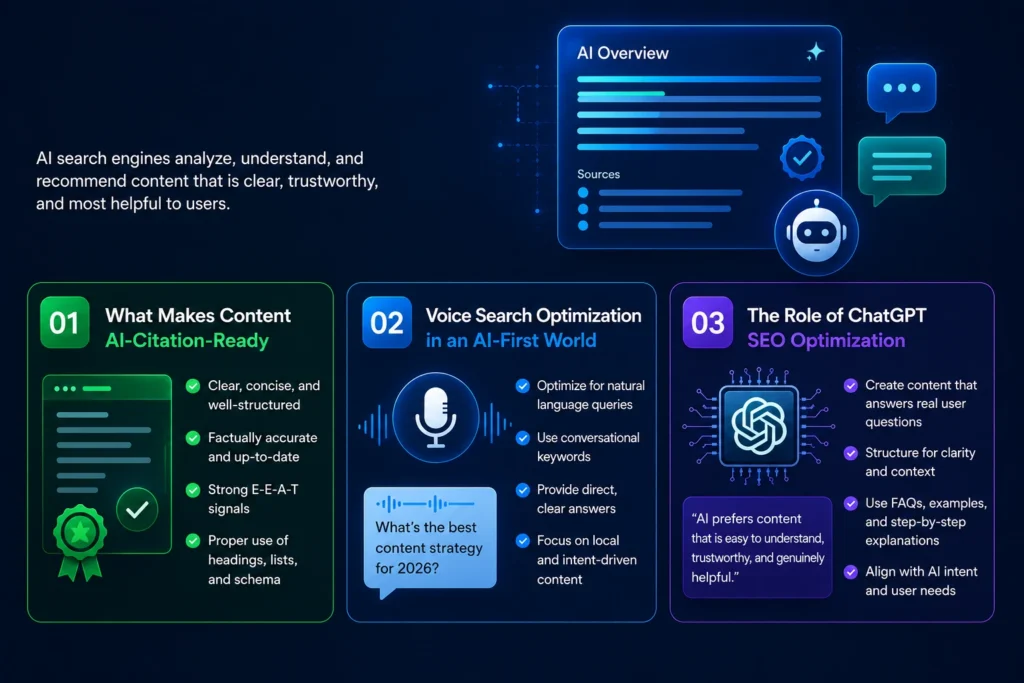
1. What Makes Content AI-Citation-Ready
- Direct answers in the first 50 to 80 words of each section
- Clear question-and-answer formatting using H2 and H3 headers
- Schema markup like FAQ, HowTo, and Article schema
- Factual claims backed by named sources and real data
- Strong E-E-A-T signals through author bios, citations, and verified expertise
2. Voice Search Optimization in an AI-First World
Voice search optimization has become even more important as AI assistants pull answers from the same pool as Google AI Overviews. When a person asks their phone a question using voice, the answer comes from content already created for AI citation.
Conversational phrasing, question-based headers, and concise definitions are essential for effective voice search optimization today. These elements help search engines understand user intent better and provide relevant answers.
3. The Role of ChatGPT SEO Optimization
ChatGPT SEO optimization means creating content that ChatGPT and similar large language models will surface when users ask questions in your niche. ChatGPT now handles approximately 2.5 billion queries per day. Your brand needs to be part of those answers.
ChatGPT SEO optimization means sharing clear and trustworthy content on topics your audience looks for. It’s also important to ensure that this content can be indexed and crawled by AI systems.
Google AI Overview SEO: The Ranking Factors You Need to Know in 2026
Google AI Overview: SEO is its own discipline. Getting cited in an AI Overview is different from ranking on page one. The AI Overview ranking factors that matter most right now are content trustworthiness, topical depth, and structural clarity.
Content that appears in Google AI Overviews gets seen at the top of the page. Content that does not is pushed below the fold, where fewer users ever scroll.
The Core AI Overview Ranking Factors
- Topical authority matters more than individual page metrics. Sites that cover a subject comprehensively get cited more often.
- Structured data helps AI systems parse your content with confidence. Schema markup directly improves citation rates.
- Content freshness is a strong signal. Stale information gets replaced quickly in AI-generated search results.
- Source credibility is evaluated through E-E-A-T signals, backlink quality, and real-world author credentials.
How to Optimize for Google AI Overview
To optimize content for AI search engines, your starting point is rewriting every major page around the question it answers. Every H2 heading should read like a question your target audience would type or speak. Your opening paragraph under each heading must answer that question directly before elaborating. This structure is what powers how to optimize for Google AI Overview successfully.
To rank well in Google AI, follow these best practices:
- Use real statistics in your content.
- Include internal links to create topical clusters.
- Earn mentions from credible sources in your industry.
AI Overview ranking factors reward content ecosystems, not isolated pages.
SEO for Generative AI Search: How AI Is Changing SEO in 2026
How AI is changing SEO in 2026 goes beyond just adding AI-generated content to your site. The real change is that SERP evolution has moved the goal from ranking to being referenced. When a user sees an AI Overview, they often read the summary and stop. The sites that get cited in that summary earn brand impressions even without a click.
SEO for generative AI search requires thinking like a reference source, not just a content creator. Encyclopedias do not keyword stuff. They define, explain, and cite. Your content needs to do the same. SEO for generative AI search means becoming the most reliable, clearly structured voice on your topic so AI systems have no reason to skip you.
AI search is replacing traditional SEO in the sense that zero-click journeys are becoming the norm. But brands that appear inside AI answers build awareness and trust even without the click. That is a new kind of value that most businesses have not yet learned how to measure.
SEO vs AEO Which Is Better for 2026 and Why You Do Not Have to Choose
- The real answer to SEO vs AEO which is better for 2026 is that they are not competing strategies. They are complementary layers of the same visibility framework.
- SEO builds your organic traffic engine. It drives clicks, leads, and conversions from users who move past the AI answer and want to explore further. AEO puts your brand inside the answer itself. Together, they ensure that whether a user reads the summary or digs deeper, your business is present at both touchpoints.
- The best AEO strategies for AI search do not require abandoning your existing SEO investment. They require upgrading how you structure content, how you use schema markup, and how deliberately you target question-based queries. For most businesses, the migration is less painful than they expect.
- Beyond SEO and AEO, technical fixes for Google Discover traffic offer another visibility layer—optimizing page experience and content signals to capture discovery-based traffic outside traditional search results.
Best SEO and AEO Strategies for USA Businesses and Beyond
For USA & Indian businesses competing in 2026, the stakes are particularly high. Mobile-first audiences and voice search are growing fast. With more people online, AI-generated search results are now the main way millions of users find information. The window to get ahead of this shift is narrowing.
 Here are the best SEO and AEO strategies for businesses ready to compete in the AI search era.
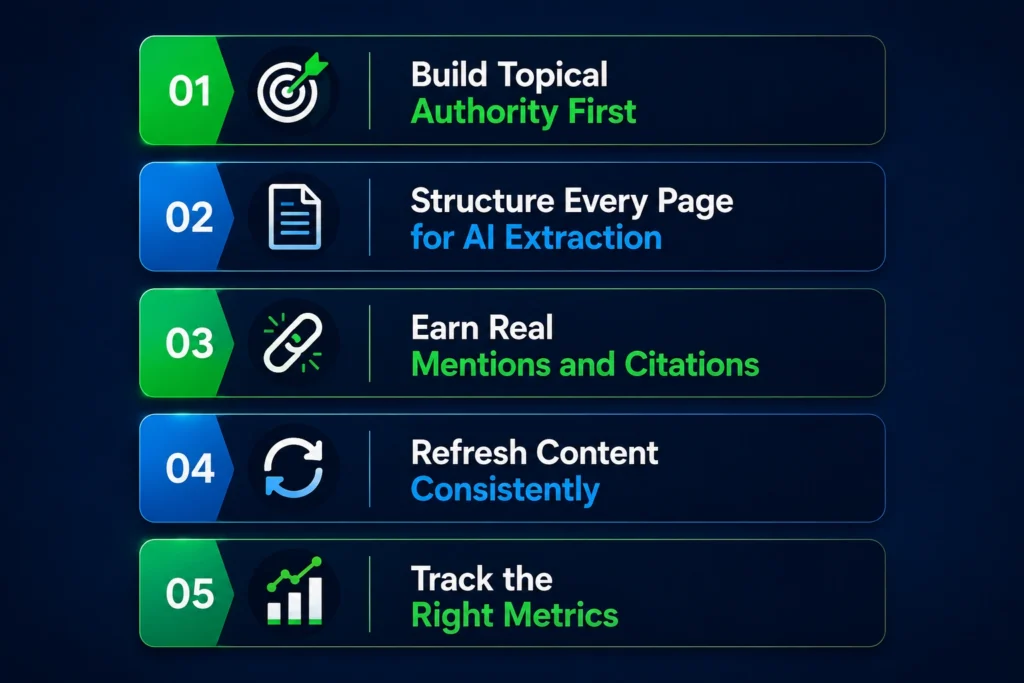
1. Build Topical Authority First
Pick three to five core topics that your business genuinely owns. Create a cluster of interlinked content around each one. Google and other AI engines reward depth. A site with twenty pages on one topic consistently outperforms a site with one page on twenty topics when it comes to AI citation rates.
2. Structure Every Page for AI Extraction
Rewrite your H2 headings as questions. Put the direct answer in the first two sentences under each heading. Use bullet lists for steps and comparisons. Add the FAQ schema to every informational page. These structural choices directly improve your chances of appearing in AI Overview results and voice assistant answers.
3. Earn Real Mentions and Citations
AI systems are trained on the broader web. If reputable sites in your industry mention your brand, reference your data, or link to your content, your authority score in AI systems goes up. Digital PR, original research, and expert commentary are top investments for boosting long-term Google AI Overview SEO.
4. Refresh Content Consistently
The AI Overview update by Google is fast. Outdated statistics and stale examples get replaced in AI answers quickly. Build a quarterly content refresh process for your highest-traffic pages. Update stats, add fresh case examples, and rework headings using the latest query data. An AI Overview update by Google often reshuffles citations, so fresh content always has an edge.
5. Track the Right Metrics
Standard organic traffic metrics will not tell the full story anymore. Include AI visibility tracking, track brand mentions, and review featured snippet performance in your reports. These signals reveal whether your Google Discover SEO tips and AEO efforts are generating brand impressions even in zero-click scenarios.
SEO Mistakes Businesses Should Avoid in 2026
The SEO trends changing in 2026 have also made old habits more costly. These are the SEO mistakes businesses should avoid in 2026 if they want to stay competitive.
- Writing content for keywords only, without thinking about the specific question being answered
- Ignoring schema markup and structured data, which are now direct signals for AI citation eligibility
- Publishing thin pages with fewer than 800 words on topics that require depth to earn AI trust
- Neglecting mobile performance and Core Web Vitals, which affect both traditional rankings and AI crawl priority
- Treating voice search optimization as a niche tactic rather than a mainstream requirement
- Not updating content regularly leads to quick decay in AI-generated search result citations.
The future of Google Search and AI rewards businesses that think like trusted reference sources. If your content would not be worth citing in an encyclopedia, it will not be cited in an AI Overview either. SEO isn’t dead in 2026-it’s evolved. If you’re still asking, “Is SEO dead in 2026?“ the answer lies in adapting to AI-driven search, not abandoning optimization altogether.
Ready to Rank in Google AI Overviews?
Ready to get your business featured in Google AI Overviews? At Mount Web Technologies, we help brands build visibility across both traditional SEO and AI-powered search results. Our strategies are crafted for how search works in 2026. We cover technical SEO, schema implementation, topical authority, and citation optimization.
Book a free SEO and AEO strategy session with our experts. We will check your current search presence. Then, we’ll find missed AI visibility opportunities. Finally, we’ll create a practical roadmap to help your business rank, get cited, and stay ahead in the changing search landscape. Book Your Free Strategy Session.
Frequently Asked Questions
Q1. What is the main difference between SEO and AEO in 2026?
SEO vs AEO 2026 comes down to the goal. SEO targets page rankings while AEO targets citations inside AI-generated answers.
Q2. How do AI Overview ranking factors affect my website traffic?
Strong AI Overview ranking factors, like structured content and topical authority, directly decide whether Google cites your page in AI answers.
Q3. How do I optimize content for AI search engines?
To optimize content for AI search engines, start by answering questions in your first paragraph. Also, use clear headings and schema markup.
Q4. Is SEO for generative AI search different from traditional SEO?
SEO for generative AI search requires deeper content structure and real authority signals beyond just keywords and backlinks.
Q4. What are the best AEO strategies for AI search in 2026?
The best AEO strategies for AI search include question-based headings, FAQ schema, and building topical authority across content clusters.
Q5. How does ChatGPT SEO optimization help my business?
ChatGPT SEO optimization helps your brand appear in conversational AI answers where billions of users search daily across platforms.
Q6. How to rank in AI answers without starting from scratch?
To improve AI rankings, update existing pages with clear answers. Add schema markup and refresh stats to show content is current and credible.