
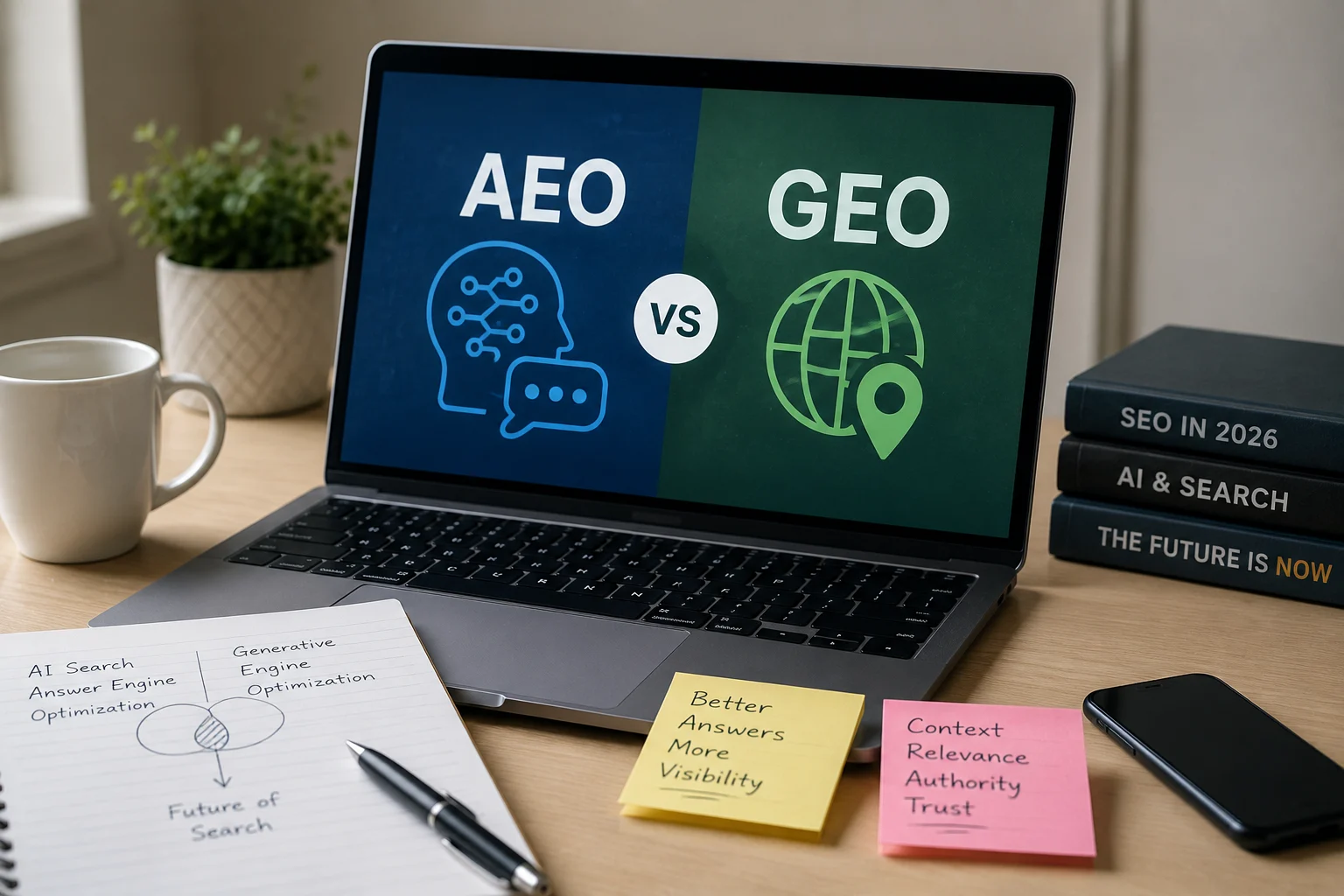
Quick Summary
- AEO vs GEO are two distinct strategies that decide whether your business appears inside AI-generated search results or gets buried entirely.
- Learn the real difference between AEO and GEO and why treating them as the same thing is costing businesses visibility in 2026.
- Learn how Google Gemini optimization and ChatGPT search optimization function. Discover what each platform seeks in practice.
- Get the best strategies for AEO and GEO that Indian businesses can implement today without starting from scratch.
- GEO vs SEO vs AEO explained in plain language so you know exactly which layer to invest in for your business goals.
- Walk away with a clear action plan to start ranking in AI answer engines and secure the future of generative engine optimization for your brand.
If you asked Google a question in 2023, you got ten blue links. If you ask the same question today, you get a fully formed answer generated by AI before you ever see a single link. That is the world your business is operating in right now. And the question is no longer just “how do I rank on Google?” The question is “how do I get cited by the AI systems that are now answering my customers’ questions?”
That is where AEO vs GEO becomes the most important strategic conversation in digital marketing. AI search trends for 2026 show that ChatGPT has over 800 million weekly users. Gemini tops 750 million monthly users. Also, Google AI Overviews show up on almost half of all search result pages. If your content is not built for these systems, your audience will find your competitors instead.
AEO vs GEO: Understanding the Two Disciplines That Define Search in 2026
Most marketers treat these as the same thing. They are not. Understanding the difference between AEO and GEO is the starting point for building a strategy that actually works on AI-powered search platforms.
Answer Engine Optimization targets short, direct answers. Featured snippets, voice assistant responses, FAQ boxes, and quick definitions all fall under AEO. The goal is to be the source that answers a specific question immediately and concisely. Generative Engine Optimization is broader. It focuses on AI systems like ChatGPT, Gemini, and Perplexity.
These systems gather information from various sources to create complete, conversational answers. GEO is about being cited as a trusted reference inside those synthesized answers.
| AEO (Answer Engine Optimization) | GEO (Generative Engine Optimization) |
| Targets direct answer boxes and featured snippets | Targets citations inside AI-synthesized responses |
| Best for short, specific, factual questions | Best for comprehensive, research-based topics |
| Works on Google, voice assistants, Alexa | Works on ChatGPT, Gemini, Perplexity, Claude |
| Focuses on FAQ schema and concise formatting | Focuses on E-E-A-T, entity authority, and depth |
| Measures success through snippet appearances | Measures success through AI citation frequency |
The answer to AEO vs GEO which is better in 2026 is that smart businesses use both. AEO wins the short-answer game. GEO wins the trust and citation game. Together, they cover every touchpoint where AI now answers your customers. For a deeper comparison of ranking in traditional results versus AI Overviews, see our guide on SEO vs AEO: Best Strategies for 2026.
How GEO Works in AI Search Engines: What Gets Cited and Why
Understanding how GEO works in AI search engines starts with understanding what these systems are actually doing. Platforms like ChatGPT, Gemini, and Perplexity do not rank pages in a list. They read many sources, pick the most reliable and clear information, then combine it into one answer. Your content either makes it into that synthesis or it does not.
 That is a concrete, measurable signal. GEO marketing strategies based on this finding always do better than generic content strategies. This is true when we look at AI citation frequency.
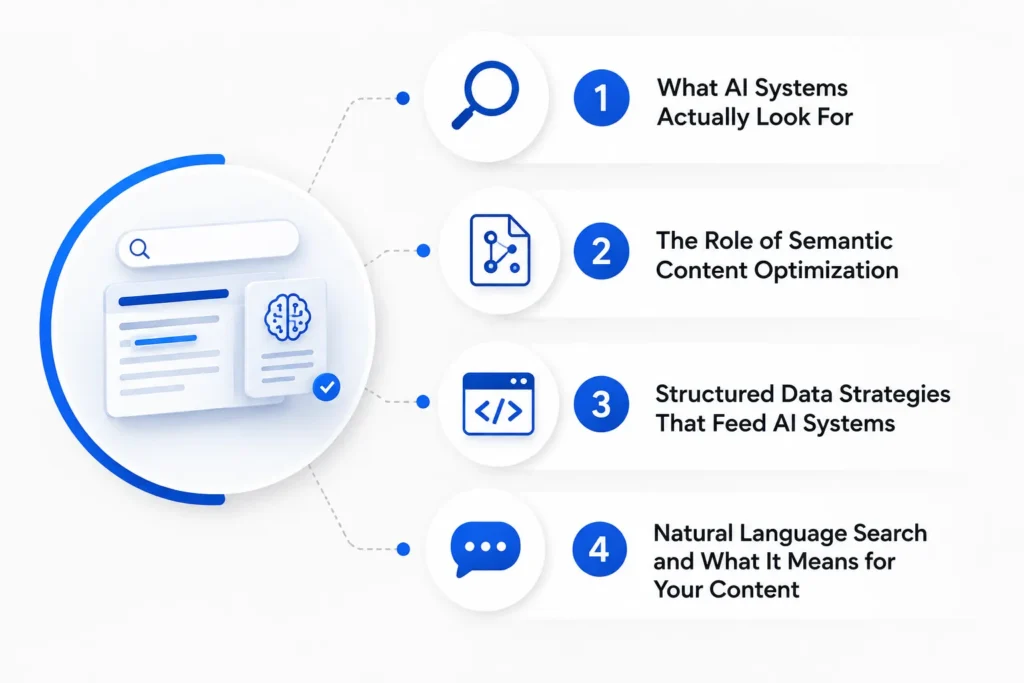
1. What AI Systems Actually Look For
AI search platforms assess content in unique ways. So, your optimization strategy needs more than just traditional SEO. Understanding how these systems prioritize content is essential for improving visibility across AI search environments.
| Platform | What It Prefers | How to Optimize |
| ChatGPT | Trustworthy domains, information dense text, and clear heading hierarchy | Write detailed, fluff free text using organized H2 and H3 structures |
| Google Gemini | Traditional Google ranking signals, technical health, and deep topical authority | Build high quality backlinks and maintain a flawless technical SEO setup |
| Perplexity AI | Verifiable data, clear references, and trusted source citations | Back every claim with highly accurate, credible facts and source links |
Learn more in our dedicated piece on how ChatGPT uses SEO to drive growth and revenue.
2. The Role of Semantic Content Optimization
Semantic content optimization means writing for meaning, not just for keywords. AI systems use natural language processing to evaluate whether your content fully covers a topic or just skims it. Content that fully answers the main question and related follow-ups gets more AI citations. In contrast, content that only touches the surface receives far fewer citations. This is what separates genuine topical authority from keyword stuffing.
3. Structured Data Strategies That Feed AI Systems
Structured data strategies are no longer optional in 2026. Sites using full JSON-LD schema markup show up in 47% more AI-generated responses than those without, as per BizAI’s analysis. FAQ schema, Article schema, HowTo schema, and Organization schema help AI engines find, check, and reference your content more easily. To understand exactly what crawlers extract from your pages, read What AI Sees When It Visits Your Website.
4. Natural Language Search and What It Means for Your Content
Users on AI answer engines do not type two-word queries. They ask full questions in conversational language. Natural language search behavior means your content should have question-based H2 headings. Also, include direct answers in the first two sentences of each section. Use clear, jargon-free language throughout. If a ten-year-old cannot understand your answer, an AI system will likely skip it in favor of a clearer source.
AEO Optimization Techniques That Work Across Google, Gemini, and ChatGPT
Effective AEO optimization techniques focus on making answers clear, structured, and easy for AI systems to extract. Every important question should have its own H2 or H3 heading, with the direct answer placed in the first one or two sentences. FAQ schema, bullet points, and numbered lists help improve visibility in Google AI Overviews, Gemini, and voice search results.
To optimize content for ChatGPT, Gemini, and other AI bots, treat your content like a trusted reference source instead of promotional copy. Keep paragraphs short, place important statistics within the first 200 words, and use credible named sources to support claims. According to GenOptima tracking, content sections with three or more verifiable statistics per 300 words receive 2.1 times more AI citations across ChatGPT, Perplexity, and Copilot.
GEO vs SEO vs AEO Explained: The Formula That Wins in 2026
The simplest way to think about GEO vs SEO vs AEO explained is to think in layers. SEO builds the foundation. AEO captures direct answers. GEO earns citations inside AI-synthesized responses. Here is how each one works and where it fits.
| What It Measures | SEO | AEO | GEO |
| Primary goal | Rank in organic search results | Appear as a direct answer or snippet | Get cited in AI-generated responses |
| Platforms it targets | Google, Bing | Google, voice assistants, Alexa | ChatGPT, Gemini, Perplexity, Claude |
| Key content signals | Keywords, backlinks, page speed | FAQ schema, concise Q&A format | E-E-A-T, entity authority, named citations |
| Success metric | Organic traffic and ranking position | Featured snippet and answer box wins | AI citation frequency and brand mentions |
| Content style | Keyword-optimized long-form pages | Short, direct, question-based answers | Comprehensive, data-rich, structured depth |
| Role in 2026 | Foundation that supports AEO and GEO | Captures zero-click and voice queries | Extends visibility into AI-first search |
According to Gartner, traditional organic search traffic to commercial websites will decline 25% by 2026 as users migrate to AI-powered interfaces. The future of generative engine optimization is not a replacement for SEO. It is the next essential layer. This shift is part of a larger pattern we explored in The Future of Digital Marketing: AI, Automation & Search Evolution. Businesses that add GEO and AEO on top of a strong SEO foundation will dominate across every modern search touchpoint.
Best Strategies for AEO and GEO: How AI Is Changing Search Marketing
AI is changing search marketing by shifting where buying decisions are made. When a potential customer asks ChatGPT for SEO agencies in India, it provides answers based on trusted sources. These sources are well-structured and reliable. If your website is not one of those sources, that customer never sees your brand. Here are the best strategies for AEO and GEO that work in practice.
- Build topical clusters of three to five interlinked pages around each core subject your business owns
- Rewrite your most important pages so every H2 heading reads as a direct question
- Place verifiable statistics with named sources within the first 200 words of every article
- Add FAQ schema, Article schema, and Organization schema to every relevant page
- Publish original research or data that other sites in your niche will reference and link to
- Refresh high-traffic pages quarterly to maintain temporal relevance signals that AI systems favor
- Monitor your brand’s citation frequency across ChatGPT, Gemini, and Perplexity using AI visibility tools
GEO marketing strategies work best when they are built on real authority, not shortcuts. AI systems are trained to detect thin content and ignore it. The more useful and well-sourced your content is, the more it gets citations on major AI platforms. This means wider reach and greater credibility. Visibility isn’t limited to AI Overviews and chatbots either – Google Discover remains a major zero-click traffic source, and we’ve covered the exact technical fixes that help you increase Google Discover traffic.
AI Overview Ranking Strategies for Google Search in 2026
The AI Overview update by Google has changed what ranking means. Here are the four AI Overview ranking strategies that get your content cited consistently.
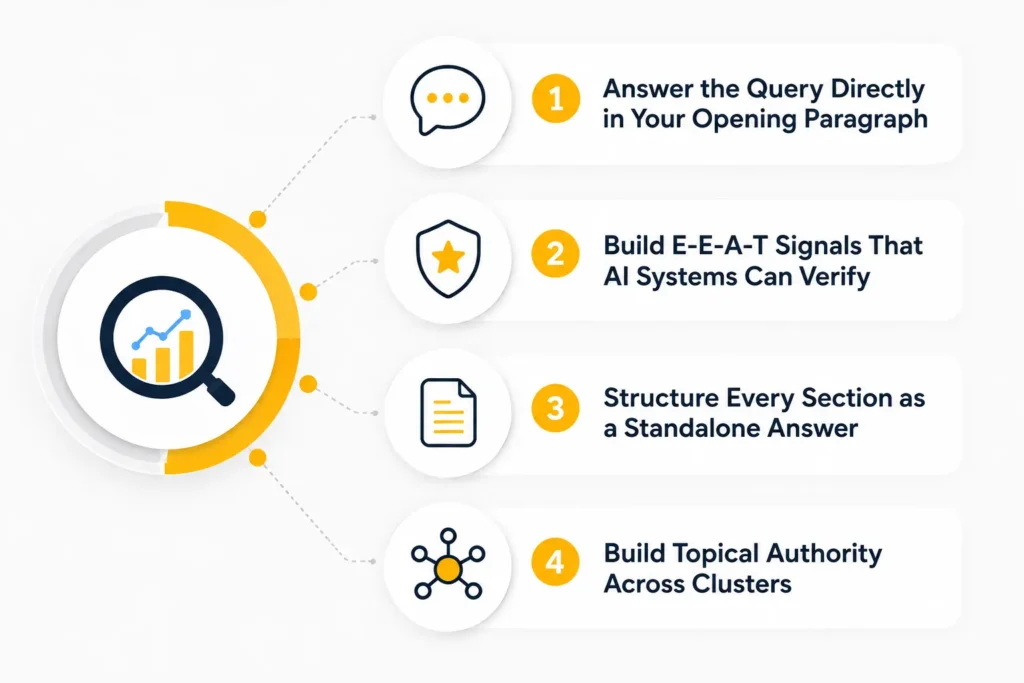
1. Answer the Query Directly in Your Opening Paragraph
AI systems scan the first 200 words of your content before anything else. Your main answer must appear in the very first paragraph of every page, not after background context or brand introductions. If the answer is not immediately visible, the AI moves to a source that makes it easier. This is the single highest-impact change most websites can make today to improve GEO optimization for AI Overviews.
2. Build E-E-A-T Signals That AI Systems Can Verify
Google’s generative layer relies on the same trust signals as traditional search but weighs them more heavily. Author credentials in the byline, verifiable stats with named sources, and links to external sites boost the E-E-A-T foundation. This foundation helps Google decide if it can trust your content.
3. Structure Every Section as a Standalone Answer
To optimize for Google AI Overview, treat every H2 and H3 section as an independent unit that makes sense on its own. AI systems frequently extract a single paragraph or bullet list from your page without any surrounding context. When each section stands alone as a complete answer, your content is easier to extract. This makes it more likely to show up in AI-generated search results.
4. Build Topical Authority Across Clusters
The AI Overview update from Google rewards domains that show deep expertise in a subject. It doesn’t favor sites that just post one good article without more related content.
Build a cluster of three to five interlinked pages covering every angle of your core topic. When AI systems notice your domain covers a topic well, citation frequency increases in both Google AI Overview and third-party engines like Perplexity and Gemini. For a step-by-step approach, check our guide on How to Get Your Site Mentioned in Google AI Overviews.
Ready to Get Cited in AI Search Results?
Book a free strategy session with our team. We’ll check your current AI visibility, find citation gaps, and create a plan for AEO and GEO. This plan will help your business be part of the answers your customers are already reading.
At Mount Web Technologies, we help businesses in India, the USA, and beyond create winning search strategies. We focus on both traditional and AI-powered environments. From technical SEO and content structure to Google Gemini optimization and AI citation monitoring, our approach is built for how search actually works in 2026. Book Your Free Strategy Session Today!
Frequently Asked Questions
Q1. What is the core difference between AEO and GEO?
AEO vs GEO comes down to scope. AEO targets direct answer placements, while GEO targets citations inside full AI-synthesized responses across multiple platforms.
Q2. How do GEO marketing strategies differ from traditional SEO?
GEO marketing strategies aim to gain AI citations by building topical depth and entity authority. This approach goes beyond simply focusing on ranking positions in traditional search results.
Q3. Does ChatGPT search optimization require completely new content?
Optimising ChatGPT search often begins with changing existing content. This means adding statistics, clear headings, and named sources. AI systems can then easily extract and verify this information.
Q4. What makes Google Gemini optimization different from general GEO?
Google Gemini optimization needs solid traditional SEO rankings first. This is because Gemini relies a lot on Google’s current organic ranking signals.
Q5. How do AI-generated search results affect website traffic?
AI-generated search results reduce direct clicks but increase brand impressions. Businesses cited in AI answers build awareness and trust even in zero-click journeys.
Q6. What are the best GEO practices for ChatGPT visibility?
The top GEO practices for ChatGPT are:
- Use dense information in paragraphs.
- Include verified statistics in the first 200 words.
- Maintain a clear H2 and H3 heading structure throughout.
Q7. How long does it take to start ranking in AI answer engines?
Ranking in AI answer engines often shows citation improvement in six to ten weeks. This happens when content is restructured with the right schema and signals of topical authority.