| Quick Summary |
|---|
Click to View Key InsightsLocal search has become one of the most important growth channels for businesses serving specific locations. Following a structured strategy helps companies improve visibility in Google Maps, AI search results, and near-me searches. Here are the most important takeaways from this local SEO checklist 2026:
|
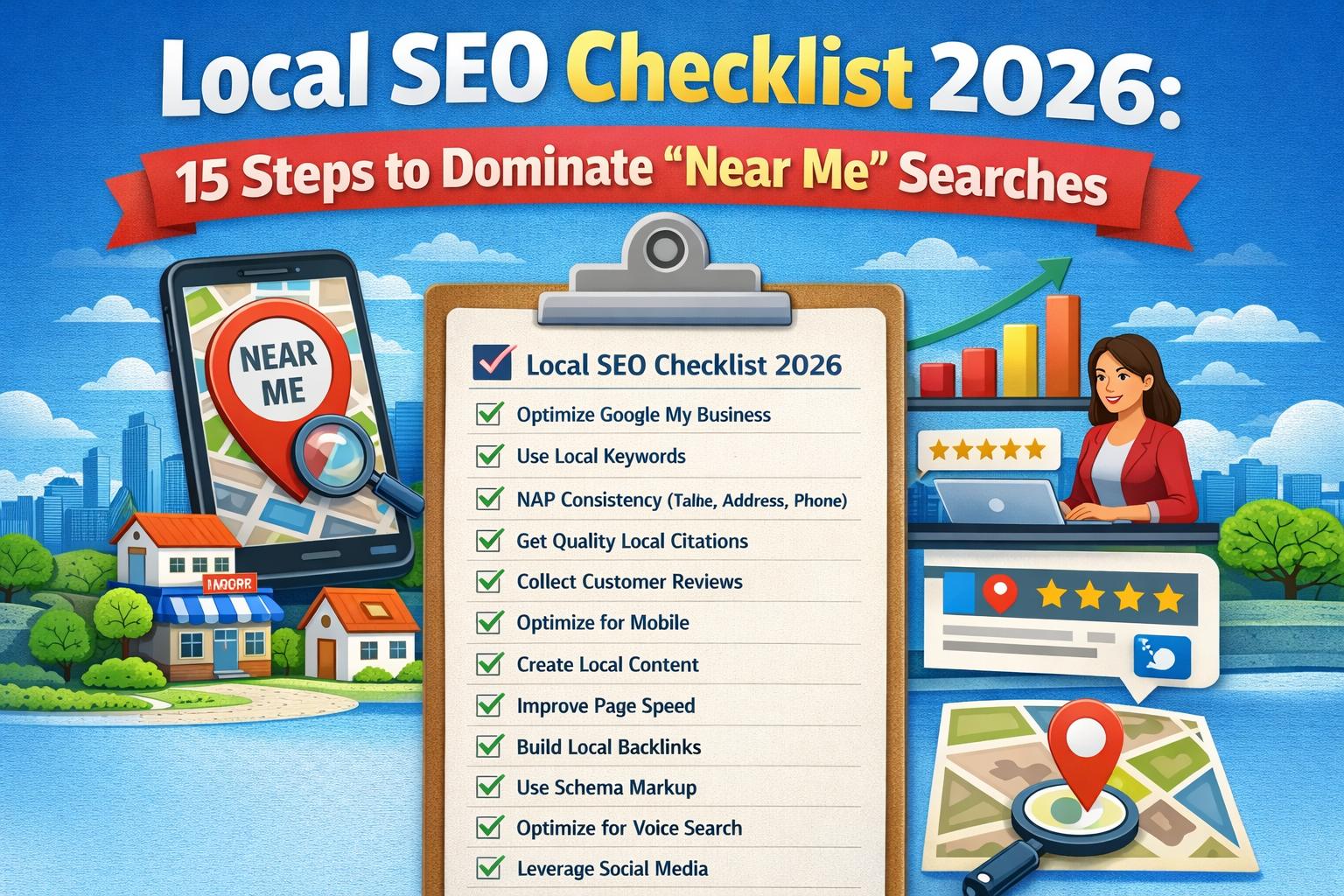
Search behavior has changed completely. In 2026, people will use voice search, AI tools, and Google Maps before they ever type a query. If your business is not showing up in those moments, you are already behind. Understanding how local SEO services work today is not optional – it is a basic survival skill for any business that serves a local area.
Google now uses AI-powered ranking signals, behavioral data, and real-time relevance checks. A business that follows the right local SEO checklist 2026 will appear exactly when a nearby customer is ready to buy, call, or visit. This guide breaks down 15 clear, actionable steps to help you win local searches in 2026.
Why Local SEO Matters More Than Ever in 2026
Key Stat: BrightLocal reports that 98% of consumers used the internet to find local businesses in 2023. This number will likely increase in 2026 as AI search goes mainstream.
Three major shifts are driving local search in 2026:
- AI Mode in Google Search: Google now shows AI-generated answers above regular results. If your business data is structured correctly, Google pulls your info into these answers.
- Near Me Search Optimization: Searches like “plumber near me” or “dentist open now” have exploded. Google handles billions of these monthly.
- Zero-Click Results: More users get answers directly from Google Maps, Business Profiles, and local packs without clicking a website.
This means your Google Business Profile optimization in 2026 and your on-page signals must work together. Let’s go step by step.
The 15-Step Local SEO Checklist for 2026
Step 1: Claim and Fully Optimize Your Google Business Profile
Your Google Business Profile (GBP) is the most important local SEO asset you have. Without it, you don’t exist in Google Maps or the local pack.
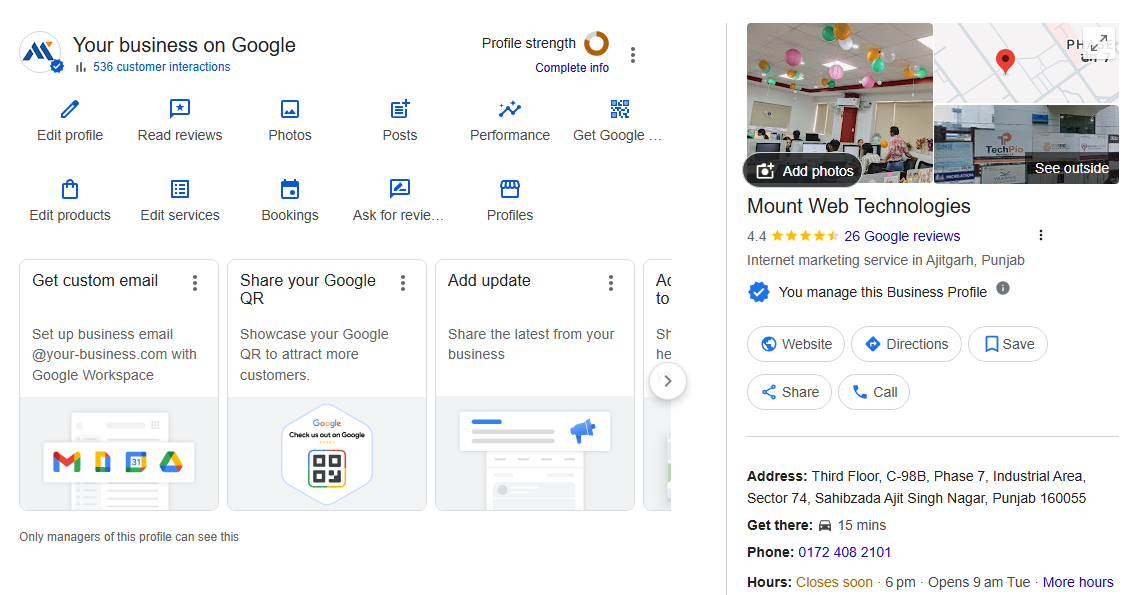
What to do:
- Claim your profile at google.com/business if you haven’t already
- Fill in every single field – name, address, phone, website, hours
- Add your primary and secondary business categories accurately
- Upload at least 10 high-quality photos (interior, exterior, team, products)
- Enable messaging so customers can contact you directly from Search
Stat: Businesses with complete Google Business Profiles are 70% more likely to attract location visits, according to Google’s own data.
Step 2: Fix Your NAP Consistency Across All Platforms
NAP stands for Name, Address, Phone number. This is one of the most basic but most broken local ranking factors in 2026. If your address reads differently on Yelp, Facebook, and your website, Google gets confused, and your rankings drop.
Action steps:
- Run a NAP audit using tools like BrightLocal, Whitespark, or Moz Local.
- Fix inconsistencies on all major directories: Yelp, BBB, Apple Maps, Bing Places.
- Use the exact same business name everywhere – no abbreviations, no variations.
- If you moved or changed your number, update every listing immediately.
In an AI-driven search era, NAP isn’t just a directory listing; it’s a verification layer. Consistent data acts as a “trust signal,” allowing AI agents to confidently recommend your physical location without risking a hallucination.
Step 3: Research and Target Local Keywords with Real Intent
Keyword research for SEO for local businesses is different from general SEO. You need keywords that combine service + location + intent.
Types of keywords to target:
- Service + City: “HVAC repair Dallas” or “best plumber Chicago”
- Near Me Variants: “emergency electrician near me” or “pizza delivery near me”
- Problem-Based: “Why is my water heater leaking” — captures early-stage intent
- Comparison Queries: “best roofing company vs handyman near me”
Use Google’s People Also Ask, Google Autocomplete, and tools like Semrush Local or Ahrefs to find real queries people search. These feed directly into AI Mode citations.
Step 4: Build Dedicated Location Pages on Your Website
If you serve multiple cities or neighborhoods, one generic homepage won’t rank for all of them. You need dedicated location pages that are actually useful, not copy-pasted templates.
Each location page should have:
- A unique H1 tag that includes the city and service
- Real content about that location – local landmarks, specific services offered there
- An embedded Google Map
- Customer reviews specific to that area, if possible
- Local schema markup (see Step 10)
This is how local SEO services for businesses with multiple locations scale their rankings without cannibalizing each other.
Step 5: Master “Information Gain” for Zero-Click & AI Search (SGE)
In 2026, the goal of local SEO has shifted from earning a click to becoming the primary data source for AI Overviews. If your content lacks “Information Gain” (unique, non-generic data points), AI models will ignore your site in favor of more detailed competitors.
The Entity-Authority Framework:
- Prioritize High-Density Entities: Move beyond simple keywords. Use local landmarks, nearby intersections, and community service proofs to establish your business as a “High-Confidence Entity” in the Knowledge Graph.
- Optimize for the “Answer Engine”: Focus your technical summaries on solving local issues. For example, provide details on emergency repair timelines during peak weather conditions instead of just listing services.
- The Proximity Signal: Rather than simply naming a city, explain your service area using clear geographical details. This way, AI can check the information against maps and local data.
The “Zero-Click” Authority Layer: In a search landscape where the AI provides the answer directly on the results page, your content must serve as the “Verified Proof.” By embedding unique expertise, you ensure the AI cites your brand as the definitive authority, building trust even when a user never visits your website.
Step 6: Build Local Citations on High-Authority Directories
Citations are online mentions of your business name, address, and phone number. More high-quality citations = stronger trust signals for Google in 2026.
Priority directories to list on:
- Google Business Profile (most important)
- Apple Maps and Bing Places for Business
- Yelp, Angi, HomeAdvisor (for home services)
- Facebook Business, LinkedIn Company Page
- Industry-specific directories (Healthgrades for doctors, Avvo for attorneys, etc.)
Affordable local SEO packages from good agencies typically include citation building as a core deliverable because it’s foundational to local trust.
Step 7: Get More Reviews and Respond to Everyone
Reviews are a direct ranking factor in Google’s local algorithm and play a major role in successful local SEO services strategies. More importantly, they are what converts searchers into customers. According to BrightLocal, 87% of consumers read online reviews before choosing a local business.
How to get more reviews:
- Send a follow-up email or text after each service with a direct review link.
- Use QR codes on receipts, invoices, or signage
- Train your team to verbally ask satisfied customers for reviews
- Never buy fake reviews – Google’s detection is much stronger in 2026
How to respond:
- Reply to every review – positive and negative
- Thank reviewers by name when possible
- For negative reviews: apologize, acknowledge the issue, and offer a resolution
Step 8: Create Locally Relevant Content Consistently
Content is how you build topical authority in a local area. This is especially important for how to improve local search rankings through organic methods.
Content ideas that work for local SEO:
- Blog posts about local events: “Best Roofing Material for Chicago Winters”
- FAQ pages targeting common local questions
- Case studies from local customers
- “Best of” lists: “Top 5 Coffee Shops Near Downtown Denver”
- Local news commentary related to your industry
Content should clearly answer real customer questions so search engines and AI Overviews can easily extract the information. Well-researched articles that demonstrate expertise, real experience, and trustworthy advice strengthen E-E-A-T signals, which is why many businesses invest in local SEO marketing services to structure content correctly.
Step 9: Build Local Backlinks from Relevant Sources
Backlinks from other local websites send strong trust signals to Google. Not all links are equal. A link from your local Chamber of Commerce is far more valuable than a generic directory listing because it comes from a trusted local source.
Research from Search Engine Journal shows that local backlink signals including the authority and relevance of linking websites account for roughly 16% of local pack ranking influence in recent algorithm studies. Strong local backlinks help search engines verify that your business is genuinely connected to the community it serves.
Where to earn local backlinks:
- Sponsor local events, sports teams, or charity drives
- Get listed in local news sites and blogs as a source or expert
- Partner with non-competing local businesses for cross-promotion
- Donate to or volunteer with local nonprofits that list supporters
- Join your city’s Chamber of Commerce, which typically provides a member link
Step 10: Add Local Schema Markup to Your Website
Schema markup is code that tells search engines exactly what your content means. For local businesses, it is one of the most powerful but underused tactics.
Key schema types for local businesses:
- LocalBusiness schema: Name, address, phone, hours, coordinates
- Review schema: Shows star ratings in search results
- FAQPage schema: Gets your FAQ content into AI-generated answers
- Service schema: Defines specific services you offer
You don’t need to code this manually. Use Google’s Structured Data Markup Helper or plugins like Rank Math (WordPress) to generate schema automatically. This directly feeds near me search optimization.
Step 11: Ensure Your Website Is Mobile-First and Fast
Over 70% of local searches happen on mobile phones. Google uses mobile-first indexing, which means it evaluates the mobile version of your site before the desktop version.
Technical requirements for 2026:
- Core Web Vitals pass: LCP under 2.5 seconds, CLS under 0.1, FID/INP under 200ms
- Tap targets (buttons, links) are large enough to click on a small screen
- No intrusive pop-ups that block mobile content
- Click-to-call phone numbers on mobile
- Images compressed and served in WebP or AVIF format
Tools to test: Google PageSpeed Insights, GTmetrix, and Chrome DevTools.
Step 12: Optimize for Voice Search and Conversational Queries
Voice search has changed how people phrase queries. Instead of “plumber Chicago,” someone might say “Hey Google, find me a licensed plumber near me who is open right now.”
How to optimize for voice:
- Create FAQ content that answers questions in natural, spoken language
- Target long-tail phrases that mimic conversational speech
- Ensure your business hours and “open now” status are accurate on GBP
- Add a speakable schema to key sections of your page
This also applies to AI assistants. When someone asks ChatGPT or Gemini for a local recommendation, the answers often come from websites that are structured for conversational queries.
Step 13: Track Your Local Rankings and Adjust Regularly
You cannot improve what you don’t measure. Local SEO marketing services that deliver results always have a clear tracking setup from day one.
What to track:
- GBP Insights: profile views, direction requests, phone calls, website clicks
- Local pack rankings for your top 10 to 15 keywords
- Organic traffic from local pages (Google Analytics 4)
- Conversion rate from local landing pages
- Review count and average rating over time
Tools to use:
- BrightLocal or Whitespark for local rank tracking
- Google Search Console for keyword impressions and clicks
- Google Analytics 4 for behavior and conversions
Pro Tip: If your rankings are high but your “direction requests” or “phone calls” are flat, your profile lacks a “hook”- update your featured photo or offer to give people a reason to click.
Step 14: Use Google Posts and GBP Features Consistently
Most businesses claim their Google Business Profile and never touch it again. That is a huge missed opportunity. Active profiles rank higher. What to post and how often:
- Offer posts: Discounts, limited-time deals – weekly or biweekly
- Event posts: Open houses, workshops, local appearances
- Product posts: Highlight your best-selling services or products
- Update posts: Business news, new hours, seasonal info Also: answer
Many SEO services for local businesses strategies fail because profiles stay inactive. Google favors businesses that regularly update their listings, post new information, and engage with customers through their Google Business Profile.
Step 15: Build a Strong Internal Linking Structure for Local Pages
Internal links help Google understand which pages are most important on your site and how they relate to each other. For local SEO, this is especially important if you have multiple service areas or service types.
Best practices:
- Link from your homepage to each city landing page
- Link from blog posts to relevant service pages with location-specific anchor text
- Create a service area hub page that links out to all individual city pages
- Use descriptive anchor text: “AC repair in Phoenix” not “click here”
Stop buried pages from killing rankings. Proper internal linking ensures Google finds every service area easily. For local SEO for small businesses, linking from high-traffic blogs to city landing pages turns casual readers into local leads instantly.
Bonus: Local SEO for Small Businesses on a Tight Budget
Not every business can afford a full agency. If you’re handling local SEO for small businesses yourself, prioritize these three things first:
- Google Business Profile: Free, highest ROI, do this before anything else
- Reviews: Ask every satisfied customer. Zero cost, huge impact.
- NAP Consistency: Run a free audit with BrightLocal’s free trial and fix errors
Once those are solid, move into content creation and citation building. Many affordable local SEO services offer starter packages under $500/month that cover exactly these fundamentals.
Common Mistakes That Hurt Local Rankings
Many businesses fail local SEO due to simple mistakes. Common issues include:
- Incomplete Google Business profiles
- Inconsistent NAP information
- Few customer reviews
- Poor mobile experience
- Duplicate listings
- Lack of local content
Avoiding these mistakes improves local seo for small businesses results.
Conclusion
Local search in 2026 is faster, smarter, and more competitive than ever, and success depends on consistent execution. This guide covered key strategies from google business profile optimization 2026 to schema markup and voice search. Following this local SEO checklist 2026 helps businesses strengthen visibility and compete effectively in local results.
The businesses appearing in AI Mode, Google Maps, and near-me searches today started optimizing months earlier. If you are looking for the best Local SEO services, Mount Web Technologies can help. Our team builds structured strategies that drive real local visibility. Get in touch today and book a strategy call to start growing your local presence.
Frequently Asked Questions (FAQ)
What are the most effective strategies for improving local search visibility?
The best strategies are:
- Optimize your Google Business Profile.
- Keep your NAP citations consistent.
- Gather genuine customer reviews.
- Build local backlinks.
- Create location-specific pages that match nearby search intent.
What steps should small businesses follow to improve local SEO?
Start by optimizing your Google Business Profile, fixing citation consistency, collecting reviews from satisfied customers, creating location focused service pages, adding schema markup, improving mobile site speed, and publishing helpful local content.
How do I optimize Google Business Profile for local SEO in 2026?
Complete every profile field accurately, choose the correct categories, upload real photos regularly, list services clearly, collect and respond to reviews, post updates, and maintain consistent contact information across directories.
Which tools help manage and track local SEO performance?
Popular tools are:
- BrightLocal for rank tracking
- Whitespark for citation management
- Semrush Local for keyword research
- Google Search Console for impressions and clicks
- Google Business Profile Insights for engagement metrics.
How do “near me” searches affect local rankings?
Near me searches rely on proximity, relevance, and trust signals. Businesses with optimized profiles, strong reviews, accurate locations, and relevant website content appear more frequently in local map pack results.
What is AI citation and how does it affect local SEO?
AI citation occurs when search engines or AI tools reference trusted website content while generating answers. Clear and structured information boosts your business’s chances in AI-driven local search results.
How should businesses handle local customer reviews for better SEO?
Respond to every review professionally, thank positive customers, address negative feedback calmly, and encourage satisfied clients to leave reviews. Consistent engagement improves trust signals and local search visibility.
Which local SEO services company is best for local businesses?
Many agencies offer local SEO, but businesses often choose Mount Web Technologies for structured strategies, strong review management, and data-driven optimization that improves visibility in Google Maps and local search results.