
If you checked your Google Search Console recently and noticed impressions going up but clicks staying flat, you are not alone. This is happening across India and globally, and it has a name: Google AI Mode.
How to get cited in Google AI Overviews is the question every serious website owner and digital marketer needs to answer in 2026. Not “how do I rank #1.” Not “how do I get more backlinks.” The question is: does Google’s AI mention your brand, cite your content, and point users to your pages when it generates an answer?
If the answer is no, you are invisible to a growing share of search traffic, and that share is growing fast.
Google I/O 2026 happened on May 19, 2026. What was announced that day will affect every website in India that relies on organic search. This blog breaks down what changed, why it matters, and the exact steps you need to take so your site gets cited rather than skipped.
What Is Google AI Mode and How Does It Work?
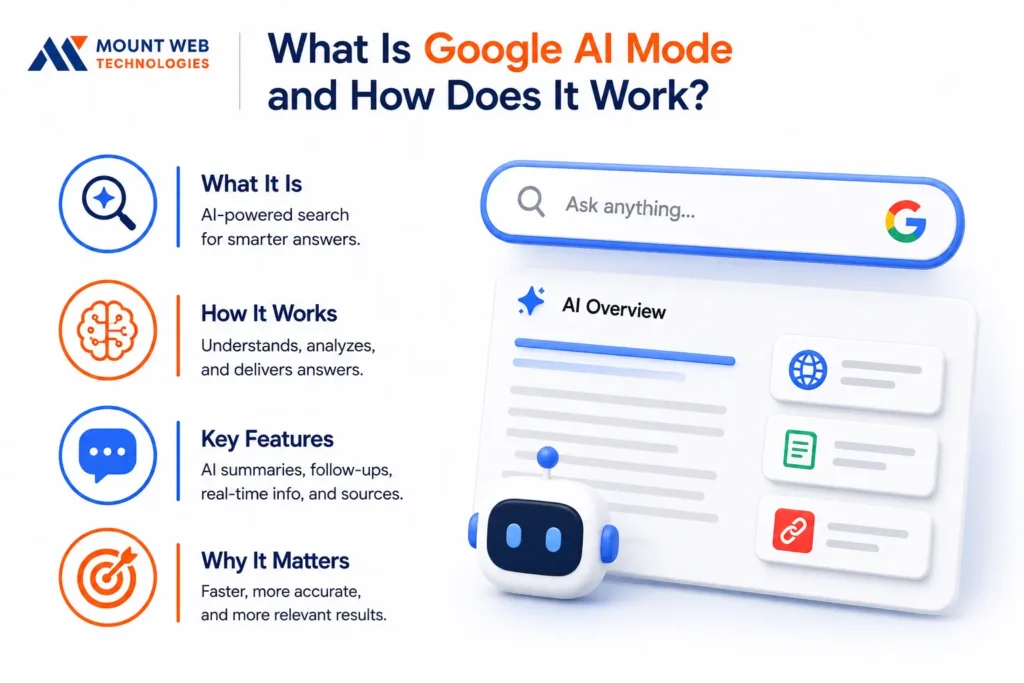
Google AI Mode is no longer a feature sitting on the side of search results. As of May 2026, it has crossed 1 billion monthly users. Liz Reid, Google’s Head of Search, confirmed that queries in AI Mode have more than doubled every quarter since launch.
Here is how it works in simple terms. When a user types a question into Google, Gemini 3.5 Flash – the new AI model from I/O 2026 takes over. It processes the query and breaks it into smaller questions. Then, it scans thousands of web pages. After that, it puts together an answer and cites 3 to 8 sources that back it up. The user reads the AI answer first. The cited links sit below it.
Your goal is to be one of those 3 to 8 cited links. Being in position 5 organically still matters, but being cited in the AI answer is now the new position zero. This is the shift most Indian websites have not yet responded to.
How Does Google I/O 2026 Affect SEO?
What did Google announce at I/O 2026 for SEO? Quite a lot. Four announcements directly change how your website gets discovered:
| Announcement | What It Means for Your Website |
| Gemini 3.5 Flash becomes default AI model | AI Overviews analyze quality and entity relationships deeply |
| Search box redesigned for first time in 25 years | Multimodal queries using video, images, and tabs are mainstream |
| Information agents go live | Systems monitor the web continuously, requiring fresher content updates |
| Personal Intelligence expands to 200 countries | Results vary by user history across Gmail and Photos |
The key headline for Indian businesses is how to rank in Google AI Mode search results for 2026. Now, it focuses on content structure, entity authority, and schema, rather than just keyword placement and backlinks.
What Is Gemini 3.5 Flash and Why Does It Matter for Search?
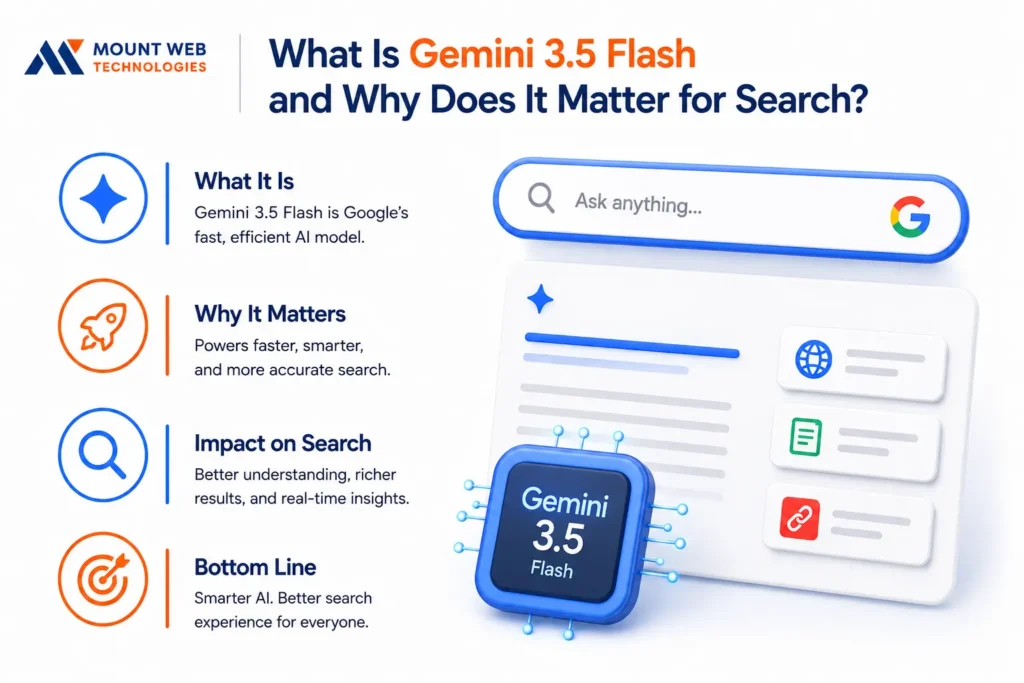
Gemini 3.5 Flash is Google’s most capable model, designed for speed and action. It beats Gemini 3.1 Pro in nearly all benchmarks. Plus, it generates output tokens about four times faster than other leading models.
What is Gemini 3.5 Flash, and why does it matter for search? A faster, smarter AI model helps Google evaluate more pages. It can weigh content quality signals better and choose sources more carefully. Surface-level keyword optimization will not satisfy it. Real depth, specific data, and verifiable expertise are what earn a citation.
Google is now processing over 3.2 quadrillion tokens every month – up from 480 trillion at I/O 2025. More queries handled by a smarter model mean your content fights harder for a citation spot. The bar is higher. The reward is greater.
What Is Generative UI in Google Search and How Does It Affect Citations?
What is generative UI in Google Search? At I/O 2026, Google added Antigravity’s coding features to Search. This lets AI create dynamic interfaces quickly for complex queries. Instead of returning a list of links, Google can now build a custom interactive experience directly inside the search result.
For questions like “how to improve SEO” or “what is topical authority,” the AI still references sources. But for product, booking, and service queries, generative UI can complete the action without a click. This is why getting featured in Google AI matters more than just ranking.
AI builds dynamic interfaces using brands that have strong SEO authority. These brands own a subject fully, rather than just focusing on single keywords.
Build Content Clusters, Not Isolated Pages
Google’s AI uses a “fan-out” process, breaking your query into many sub-queries and searching for the best answer to each. A single well-optimized page earns one citation. A content cluster that covers a topic from every angle earns citations across multiple sub-queries.
Named Entities Signal Real Expertise
Your content should mention real people, real studies, real statistics with dates, and real business names. The AI model looks for verifiable entity signals. A page that says “experts recommend” gets skipped. A page that says “According to Ahrefs’ 2026 analysis, 62% of cited pages do not rank in the top 10” gets cited.
Consistent Publishing Signals Topical Depth
One great article is not enough. Google’s information agents are now monitoring the web 24/7. Sites that regularly post on a topic create a strong presence that AI sees as trustworthy. Indian agencies and businesses should publish two to four optimized articles each month. This is the minimum to build your presence in 2026 on key service topics.
The E-E-A-T AI Overview Formula That Gets You Cited
E-E-A-T AI Overview signals have evolved. In 2026, they are not just about adding an author bio. They focus on making each page clearly trustworthy for an AI model that can read, reason, and cross-check.
| E-E-A-T Signal | What to Do |
| Experience | Include first-hand case study data, client results, or original observations instead of rephrased statistics from other sites |
| Expertise | Name the author, list credentials, link to their professional profile or LinkedIn |
| Authoritativeness | Earn mentions on third-party sites including industry blogs, news publications, and directories relevant to your niche |
| Trustworthiness | Add schema markup, cite your sources with dates, keep information updated, show a physical address and phone number |
For Indian businesses, your Google Business Profile, Clutch, or GoodFirms reviews, and published case studies help build your online authority. These are not only reputation signals. They also help AI systems recognize your business as a trusted source for citations.
How to Get Cited in Google AI Overviews: The Step-by-Step AEO Strategy
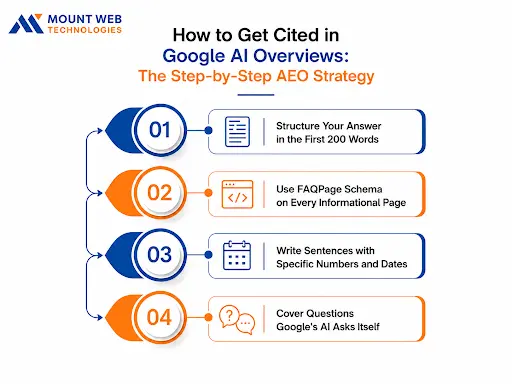
AEO strategy, or Answer Engine Optimization, is the discipline that bridges traditional SEO and AI citation. Here is how to implement it:
1. Structure Your Answer in the First 200 Words
How to get cited in Google AI Overviews begins before your reader reaches the third paragraph. The AI extractor reads your page in blocks. The first clean, direct answer it finds for a question is the one most likely to get extracted and cited. Write a one to two-sentence direct answer to your target question within the opening of each key section.
2. Use FAQ Page Schema on Every Informational Page
FAQPage schema marks up your Q&A content so the AI can parse it cleanly. Each question and answer pair becomes a discrete citation candidate. Write specific, data-backed answers — not vague responses.
3. Write Sentences with Specific Numbers and Dates
The AI Overview citation strategy 2026 data is consistent: sentences with specific numbers, named studies, and dates cite at significantly higher rates than generic prose. “Traffic can improve” gets ignored. “Sites that implemented FAQPage schema saw a 34% increase in AI Mode impressions in Q1 2026” gets cited.
4. Cover Questions Google’s AI Asks Itself
How does Google AI Mode affect my website traffic? This is the kind of question your content should directly answer. Google’s AI breaks every query into sub-questions. If your content answers the main question but misses the sub-questions, you will be outranked in the AI layer by a page that answers all of them. Map your content to the full question tree, not just the head keyword.
Is SEO Dead After Google I/O 2026?
No. But the definition of winning has changed.
Is SEO dead after Google I/O 2026? The question itself explains why so many websites are losing visibility. Teams that spent 2025 asking this question waited for answers. Meanwhile, their competitors built topical authority, added schema markup, structured content for AI extraction, and earned citations. Traditional ranking factors like technical SEO, backlinks, and page speed still matter. They are now the foundation, not the final goal.
In 2026, the real goal is getting featured in Google AI results. Websites earning AI citations are the ones:
- Treating GEO, or Generative Engine Optimization, as an essential strategy alongside traditional SEO
- Building strong entity authority across the web
- Creating content that AI systems can easily extract and understand
- Publishing consistently so Google recognizes them as reliable information sources
Google has redesigned search for the first time in 25 years. The traditional search experience people relied on for decades is now being replaced by AI driven search. This is not an exaggeration. It is exactly what Google’s Head of Search confirmed at I/O 2026. The question is no longer whether businesses should adapt. The real question is how quickly they can move forward.
Start Getting Cited with Mount Web Technologies
Stop losing clicks while impressions grow. Mount Web Technologies builds the topical depth, structured data, and E-E-A-T signals required to dominate Google AI Overviews. Secure your search visibility today. Book your FREE consultation now.
Frequently Asked Questions
Q1. What is Google AI Mode and how does it work?
Google AI Mode uses Gemini 3.5 Flash to synthesize answers from multiple web pages and cites 3 to 8 sources directly inside the search result.
Q2. How does Google I/O 2026 affect SEO?
It introduced smarter AI models, a new search box, and background agents. These agents monitor the web and change how content appears.
Q3. How to get cited in Google AI Overviews in 2026?
Structure direct answers in the first 200 words, use FAQPage schema, build topical authority SEO, and strengthen E-E-A-T signals with named experts and verified data.
Q4. What is Gemini 3.5 Flash, and why does it matter for search?
It is Google’s fastest frontier AI model, now powering all Google AI Mode globally, evaluating content depth and entity signals more precisely than older models.
Q5. What is generative UI in Google Search?
Google now creates dynamic interfaces in search results for complex queries using agentic AI. This means content must be extractable, not just rankable.
Q6. How do Google search agents work?
Search agents work around the clock. They watch the web for topics you care about and send updates. This means your content must be fresh and published regularly.
Q7. What is an AEO strategy, and how does it differ from SEO?
AEO strategy or Answer Engine Optimization focuses on structuring content so AI systems extract and cite it directly, beyond keyword ranking, into entity authority and schema.