
ChatGPT is the 5th most-visited website in the world. It has never run a single paid ad. Here is exactly how it happened and what you can learn from it.
In September 2025, Sam Altman announced that ChatGPT had crossed 800 million weekly active users & nearly 10% of the world’s adult population. The site now receives 5 billion visits every single month and ranks as the 5th most visited website globally.
No Super Bowl ad. No billboard. No Google Ads campaign. Just product, content, and code working together in a loop that most companies have not built yet. That loop is what we now call ChatGPT SEO – a system where visibility, user intent, and content scale compound without paid acquisition.
This blog breaks down exactly how that loop works. We’ll use a simple framework called the 3Cs – Code, Content, and Conversions to show you what OpenAI built, why it works, and what you can steal from it starting today. No jargon. No fluff. Just the actual mechanics.
First, Let’s Clear the Confusion: Is ChatGPT Killing SEO or Using It?
Before we talk about what ChatGPT is doing with SEO, we need to address the headline that’s been circulating for two years: “SEO is dead because of AI.”
It isn’t. But the fear is real, and it deserves a real answer.
The “SEO is dead” claim is based on real fear, not real data
Some marketers said traffic dropped by 40–50% in 2025. They declared SEO was over. But these claims come from small, biased samples, not reliable data. When you look at large scale analysis, the picture changes completely and supports a clearer reality: ChatGPT didn’t kill search traffic.
- Analysis of 40,000+ major US websites showed organic SEO traffic dropped by only 2.5%, not 40%
- Google’s own traffic increased by 0.8% in 2025
- Visitor growth rose by 1.4% in Q4 2025 compared to Q4 2024
SEO is not disappearing, it is evolving. Some industries like news, health, cooking, and entertainment saw sharper declines, while categories like shopping, clothing, and marketplaces actually grew. This shift matches how AI platforms work. Visibility, intent, and user behavior feed systems like the OpenAI revenue model. So, search isn’t dying; it’s just being reshaped.
What actually caused the traffic drop and it’s not ChatGPT
Most people are blaming ChatGPT for the drop in clicks, but that is not what the data shows. The real shift started when Google rolled out AI Overviews in March 2025. Impressions and rankings stayed stable, which proves clicks were being captured earlier, not lost due to ChatGPT SEO.
CTR dropped from 15% to 8% when AI Overviews appeared, with total click volume falling by up to 58%. This clearly shows Google added a zero click layer above organic results. The change comes from product design, not any flaw in ChatGPT growth strategy or SEO itself.
What is ChatGPT actually doing to search?
ChatGPT has absorbed the top of funnel queries, the quick definitions, how-to searches, and basic comparisons people used to make on Google. It replaces the first one or two searches in a user’s journey, not the entire journey. This shift is why understanding how ChatGPT drives organic traffic matters more than ever.
Here is how it actually works. A user asks ChatGPT, “What CRM should I use?” and gets a comparison instantly. Then they move to Google and search “Salesforce vs HubSpot pricing.” That second search is high intent and still lands on organic results. ChatGPT didn’t kill search traffic. It changed where users enter the funnel. Brands that rely solely on generic top content are losing visibility. In contrast, those investing in AI content for SEO and high-intent pages are gaining an advantage.
How ChatGPT Became One of the Biggest SEO Winners Without Ads
The same tool people say is killing SEO runs one of the most aggressive organic search strategies on the internet. The numbers most people haven’t seen:
Comparative SEO Performance: ChatGPT vs. Competitors
| Metric | ChatGPT (OpenAI) | Perplexity AI | Claude (Anthropic) |
| Total Monthly Visits | 5.2 Billion | 206 Million | 219 Million |
| Organic Search Traffic | 76.5 Million | 1.7 Million | 908,000 |
| Google Branded Searches | 45.5 Million | 1 Million | 500,000 |
| Keywords Ranked | 287,800 | 184,800 | 36,000 |
| Direct Traffic Share | 80.29% | ~70% | ~65% |
| Annual SEO Talent Spend | $600,000 | Not Publicly Disclosed | Not Publicly Disclosed |
The numbers clearly show this is not accidental growth. It is a calculated ChatGPT growth strategy where brand demand, organic reach, and product experience work together to dominate search without relying on paid ads or traditional marketing channels.
The 3Cs Growth Engine: Code, Content, and Conversions
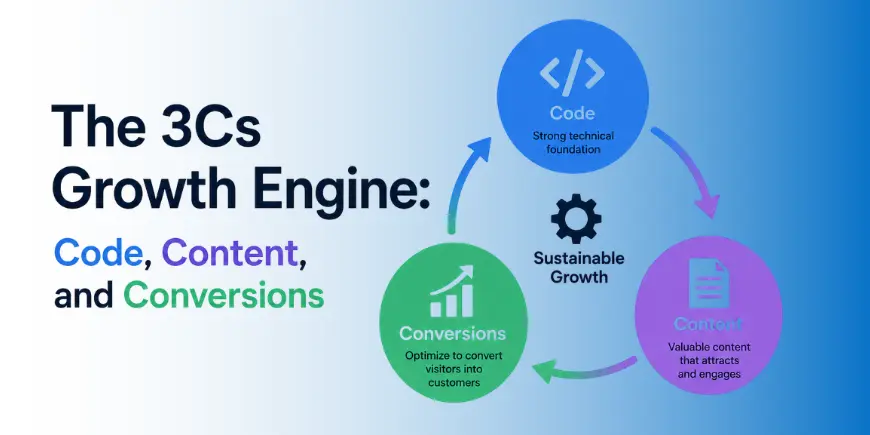
C1 (Code): The Technical Setup That Commands Google’s Respect
Most people think technical SEO is a developer thing. It is not. It simply means making your site easy for Google to read, and OpenAI does this better than almost anyone. This is a core part of ChatGPT SEO.
Two things worth copying from ChatGPT’s setup
- robots.txt done right: Most sites leave this file on default. OpenAI does not. Their setup includes multiple sitemaps, explicit crawler rules, and a clear separation. These are between three crawlers: GPTBot for training, OAI SearchBot for real-time answers, and ChatGPT User for live browsing. This is intentional infrastructure, not an afterthought.
- Clean, keyword-rich URLs: URLs with real words get 45% higher CTR compared to random strings. Across 287K pages, that becomes a compounding ranking signal.
The thing most site owners are missing right now
If you have a blanket Disallow: / in your robots.txt, you’re invisible in ChatGPT answers, Google AI Overviews, and Perplexity. Your competitors fill that space instead.
Understanding the OpenAI revenue model makes this clearer: GPTBot feeds training data, while OAI-SearchBot and ChatGPT-User power the paid product – ChatGPT’s real-time answers. Blocking the retrieval crawlers cuts you out of the product people are actually paying to use.
| # Standard search engines — always allow
User-agent: Googlebot Allow: / User-agent: Bingbot Allow: / # AI retrieval crawlers — ALLOW these so you appear in AI answers User-agent: ChatGPT-User Allow: / User-agent: OAI-SearchBot Allow: / User-agent: PerplexityBot Allow: / User-agent: Claude-Web Allow: / # AI training crawlers — block if you don’t want your content in model training data User-agent: GPTBot Disallow: / User-agent: anthropic-ai Disallow: / User-agent: Google-Extended Disallow: / # Default — block internal pages User-agent: * Disallow: /admin/ Disallow: /api/ Sitemap: https://yoursite.com/sitemap.xml |
Pro Tip: Open yourdomain.com/robots.txt. If you see User-agent: * Disallow: / without specific allowed rules for OAI-SearchBot, ChatGPT-User, and PerplexityBot – you’re invisible in AI answers. Adding those three lines is the highest-ROI action in this entire blog.
C2 (Content): A Content Machine With No Content Team
How does a chatbot rank for 287,000 keywords without writing 287,000 articles? User-Generated Content. OpenAI tried using public shared conversations as indexable pages – real users asking real questions, every chat a long-tail keyword page, $0 content budget. They pulled it back after privacy concerns emerged. But the model itself is what Wikipedia, Reddit, and Quora built their entire authority on. These are the most cited sources in Google’s AI Mode – not a coincidence.
The format that gets cited matters as much as the content itself. AI skips dense paragraphs. It cites direct answers.
The formula is simple. Use the question as the heading, give a direct 2 to 3 sentence answer immediately, then add supporting details below. No preamble and start with the answer. This structure works best when supported by the right AI tools for content marketing to ensure clarity and consistency.
Also, GPT 4 and GPT 5 rely on real time search. A page last updated in 2022 will lose to one updated recently. Add a visible “Last Updated” date on your key pages and keep them refreshed, as it now impacts citations, not just appearance.
C3 (Conversions): How 76.5M Monthly Visitors Become $10B Revenue
AI-referred traffic is not just different; it performs better. A 12-month study of 94 e-commerce brands found that ChatGPT referrals convert at 1.81%. In contrast, standard organic traffic converts at 1.39%. This means ChatGPT referrals have a 31% higher conversion rate. The reason is simple. Users coming from AI are already informed, have explored their problem, and are closer to making a decision.
Moreover, there is one important catch. Most of this traffic is misattributed in GA4. The typical journey is that a user discovers your brand through ChatGPT, closes the chat, searches your name on Google, and then visits your site. GA4 records this as branded organic, not AI driven traffic, which hides the real impact of your ChatGPT marketing strategy.
To fix this, create a custom channel in GA4 and include sources like ChatGPT, OpenAI, Perplexity, Claude, and Gemini. Once tracked properly, many businesses find that AI referral traffic converts two to three times higher than social, yet remains completely hidden until measured correctly.
What You Can Learn From ChatGPT’s SEO Playbook Right Now
ChatGPT’s growth isn’t luck. It’s a system. Here are four moves you can copy starting today as part of a clear ChatGPT content strategy explained in a practical way.
Check Your robots.txt:
Open yourdomain.com/robots.txt now. If OAI-SearchBot and PerplexityBot are blocked, you’re invisible in AI answers. Fix it in 3 minutes.
Write Answer Capsules:
AI skips long essays. Lead every page with a direct 2–3 sentence answer to the target question. That’s what gets cited.
Build a UGC Engine:
Add a public Q&A section to your site. Real user questions become real long-tail keyword pages at zero content budget.
Track AI Traffic Separately:
GA4 misattributes ChatGPT referrals as branded organic. Create a custom channel using sources like ChatGPT, Perplexity, and Claude to accurately track AI driven traffic.
The Bottom Line:
ChatGPT SEO is not about rankings anymore, it is about becoming the answer users trust inside AI systems. Visibility now depends on structure, intent, and authority. Brands that adapt early will dominate, while others relying on outdated SEO tactics will continue losing ground in AI-driven search.
With the right AI content for SEO, your business can appear directly inside AI answers, not just search results. Mount Web Technologies helps brands build AI-ready strategies that drive visibility, trust, and conversions. Start positioning your business where decisions are made. Connect with us today.