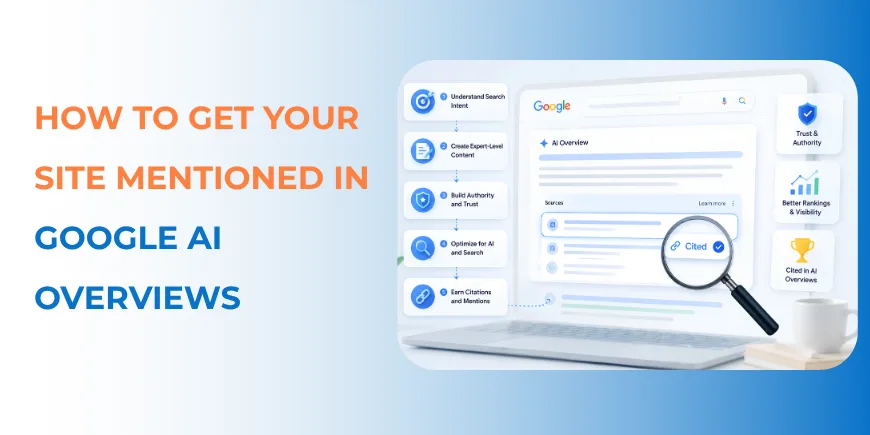
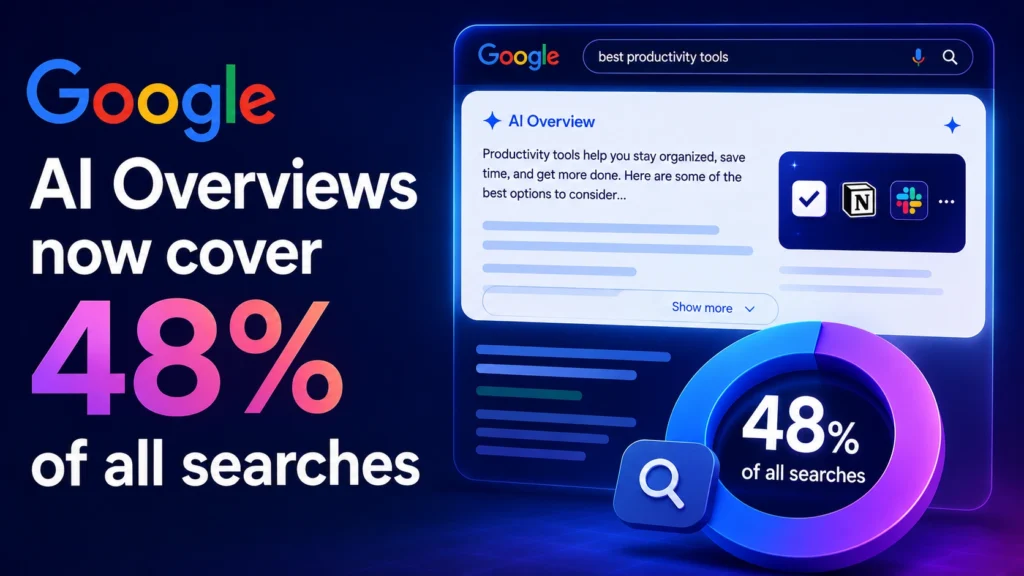
Google AI Overviews now cover 48% of all searches – What it means for your website
Quick Summary Google AI Overviews now appear on 48% of all searches, up 58% from early 2025 — this is no longer optional to understand. Organic CTR drop is real: queries with an AI Overview triggered a 61% fall in click-through rates for uncited sites. Google AI search 2026 has shifted to AI Mode as the default for millions of users, following the Google I/O 2026 Announcement with 93% of those sessions ending zero-click. Sites cited in AI Overviews earn 120% more organic clicks per impression than uncited competitors on the same query. AEO strategy (Answer Engine Optimisation) is now a parallel discipline to SEO – not a replacement, but a necessity. Small and mid-size websites can still win – the citation model favours depth, authority, and structure over domain size alone. If you checked your Google Search Console last month and noticed a quiet drop in clicks with impressions still rising, you are not imagining things. Something real changed. Google AI Overviews now show up on nearly half of all searches. Google answers the question before the user ever reaches your website. Your content may be doing everything right and still losing the click. This is not a future problem. It is happening right now. And the agencies and businesses that understand it early are the ones that will stay visible in Google AI search 2026 while everyone else tries to figure out why their traffic dropped. Here is what is actually going on, what the numbers say, and exactly what you can do about it today. What Are Google AI Overviews? A Quick Refresher on Google AI Search 2026 Google AI Overviews are AI-generated summary boxes that appear at the very top of Google search results. They pull information from multiple web pages, synthesize an answer, and present it to the user directly inside the search results page with no click needed. Powered by Google Gemini search integration, these overviews were rolled out globally in May 2024 and have grown faster than almost any other Google feature in search history. By early 2026, they will appear in over 200 countries and 40+ languages. Think of them as Google’s way of becoming the answer, not just the search engine that points to answers. That is a fundamental shift in the 25-year-old model of organic search. How Does Google AI Overview Affect My Website Traffic? This is the question most website owners are asking in 2026 and the data is now clear enough to answer honestly. Why Did My Google Traffic Drop After AI Overview? If your traffic has declined in the past 6 to 12 months, AI Overviews’ SEO impact is very likely part of the story. Here is what is happening mechanically. When a Google AI Overview shows up for a query, it takes the top spot. This pushes your organic result down, often below the fold. Users get the answer they came for and leave. The net result: even a page ranking in position 1 can see its CTR cut in half if an AI Overview is present above it. Sites that are not cited inside the overview face the steepest drop. Sites that are cited can actually gain traffic. Seer Interactive’s 2026 data shows that cited brands get 120% more clicks per impression than uncited competitors for the same query. Which Content Types Are Hit Hardest? Informational articles and how to guides are now commonly triggering AI Overviews directly in search results. Definition pages, glossary content, and FAQs are often answered directly inside the AI generated box. Top 10 lists and comparison articles are increasingly being summarized without users clicking through to websites. Transactional and product pages are less impacted right now. Users still like visiting websites to make purchases. What About Small Websites? Can small websites rank in Google AI Overviews? Yes and this is one of the most important points to understand. The citation algorithm does not weight domain authority the way traditional ranking does. A focused, well-structured page on a smaller site can and does get cited when it provides a clear, authoritative answer. Depth, specificity, and format matter more than size. SEO vs AEO in 2026: What Is the Difference? The question of what is the difference between SEO and AEO in 2026 is coming up in every serious marketing conversation right now. SEO (Search Engine Optimization) AEO (Answer Engine Optimization) Optimizes pages to rank in the 10 blue links Optimizes content to be cited inside AI-generated answers Focuses on keywords, backlinks, and technical health Focuses on direct answers, schema, and entity structure Success = top ranking position Success = being the source Google AI quotes Traffic measured by clicks to your site Value measured by brand visibility and citation authority Question-format keywords drive rankings Answer format: the first sentence directly answers the query Answer engine optimization (AEO) is not a replacement for SEO — it is an extension. In 2026, you need both running in parallel. SEO keeps your pages visible in traditional results. AEO makes sure those pages are structured in the format AI systems prefer to cite. 2026 Data: How AI Overviews Have Grown Across Industries BrightEdge tracked AI Overview presence across key industries from February 2025 to February 2026. The growth is not uniform, and some sectors have already been transformed almost completely. Here is where your industry stands today. What this means in plain terms: Google just changed how half the internet finds information. If your business relies on search traffic, now is the time to adapt. Don’t wait for another quarter of decline. The rise of Google AI search 2026 also means that brand mentions inside AI answers are becoming a new form of digital real estate. Being cited does not always drive a click but it builds brand familiarity at the exact moment someone is researching a purchase or a service. That is a powerful position to occupy, even without a click. How to Get My Website Cited in Google AI Overviews: 7 Actionable